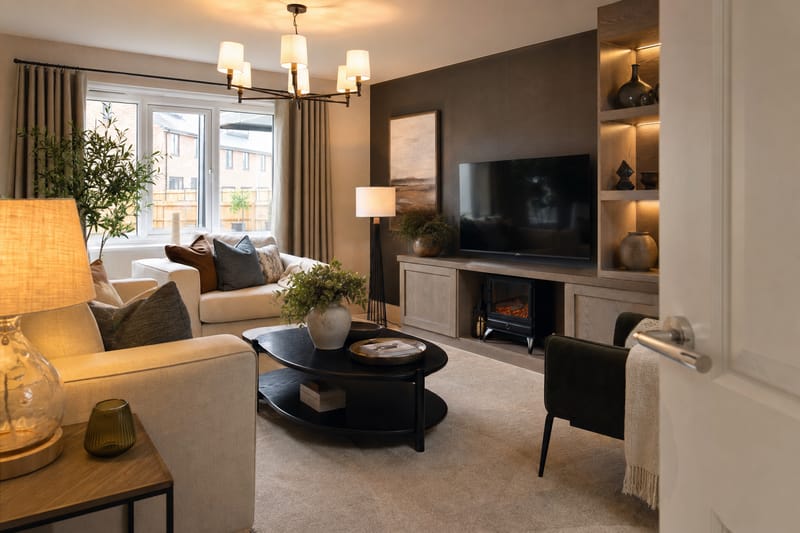
Every development eventually reaches the point where the marketing suite closes, the last few plots are being sold, and the developer has to decide what to do with the show home itself. In most cases, the answer is simple: it goes on the market like any other property, usually fully furnished and dressed exactly as you saw it during your first viewing. For buyers, this can look like the easiest purchase decision on the entire site — a finished, styled, move-in-ready home with no waiting for construction. But buying a show home is not quite the same transaction as buying a standard plot, and the differences matter to your budget, your negotiating position, and what you'll actually be living with once the developer's marketing team has moved on.
This guide covers how show home sales are structured, what "fully furnished" genuinely means in practice, the wear and tear you should expect from months or years of staged viewings, and how to separate the furniture price from the bricks-and-mortar price so you're not overpaying for either. It also looks at the specific risks of being one of the very last purchasers on a site, since a show home sale almost always coincides with a development entering its final phase.
If you're weighing up a show home against a standard new-build plot elsewhere on the same site, it's worth reading our guide on what to check before you reserve a new build alongside this one, since many of the same reservation-stage checks apply, just with an extra layer of furniture and condition questions layered on top.
Why Developers Sell the Show Home Last
A show home isn't just a house — it's a sales tool. Developers spend a genuine amount of money dressing it: interior designers, furniture hire or purchase, soft furnishings, sometimes landscaping upgrades to the garden, and often small specification upgrades (better taps, upgraded flooring, mood lighting) that aren't standard on every plot. Keeping that show home open and staffed helps sell every other plot on the site, so developers are reluctant to release it until they genuinely don't need it any more.
That means the show home usually comes onto the open market at one of these points:
- Final phase of the development — once most plots are reserved or sold, the sales office no longer needs a fully dressed example to show prospective buyers.
- When the development is winding down entirely — the sales team, portable cabin, and hoarding come down at the same time, and the show home converts to a standard sale.
- Occasionally mid-phase — on larger multi-phase sites, a developer may build a second show home for a later phase and sell the first one earlier than you'd expect, particularly if plot types differ between phases.
The practical upshot is that if you're being offered the show home, you are very likely looking at one of the last available plots, and sometimes literally the last one. That has implications well beyond furniture, which we cover later in this guide.
A show home coming to market is usually a signal the development is close to fully sold out, not a special early opportunity.
It's also worth understanding that the decision to release the show home is commercial, not regulatory — there's no fixed rule about when it must be sold, and some developers keep a show home dressed and unsold for a surprisingly long time if the site is large or sales have been slower than forecast. If you're interested in a specific show home, ask the site sales team directly for their expected release date rather than assuming it will happen on a set schedule.
What's Actually Included When You Buy a Show Home
"Fully furnished" is used loosely in marketing and it pays to get specific. Show home inclusions generally fall into three categories, and they are not automatically bundled into the property price.
1. Fixtures that transfer with the property regardless
Fitted kitchens, bathroom suites, flooring that's glued or screeded down, fitted wardrobes, integrated appliances, and any structural upgrades (bifold doors instead of standard patio doors, for example) are part of the building itself and transfer with the sale in the normal way, just as they would with any new-build purchase.
2. Furniture and soft furnishings sold as a separate package
Sofas, dining tables, beds, rugs, curtains, artwork, lamps, and styling accessories are almost always owned separately from the property and priced as an optional extra, sometimes called a "furniture pack" or "show home package." This is the part buyers most often assume is free when it isn't.
3. Display-only items that won't be included at all
Some show homes use props that are never intended to be sold on: fake books, decorative-only kitchen items, staged children's bedrooms with rented furniture, or seasonal dressing. These are removed before completion regardless of what you agree for the rest of the furniture.
| Item type | Typically included in property price? | Negotiable separately? |
|---|---|---|
| Fitted kitchen & integrated appliances | Yes | No — part of the build |
| Bathroom suites & tiling | Yes | No — part of the build |
| Fitted flooring (carpet, LVT, laminate) | Usually yes if glued/fitted | Sometimes upgraded specification is negotiated into price |
| Sofas, beds, dining furniture | No | Yes — separate furniture pack price |
| Curtains, blinds, soft furnishings | Sometimes bundled with furniture pack | Yes |
| Artwork, mirrors, decorative accessories | No | Yes, but often low value — ask if it's even for sale |
| Garden furniture & landscaping upgrades | Depends on developer | Yes, clarify in writing |
How the Furniture Package Is Usually Priced
Developers price show home furniture in one of a few common ways, and it's worth asking which model applies before you get emotionally attached to the interior you've been viewing for months.
- Bundled into the asking price — less common, but some developers fold a notional furniture value into the headline price to make the show home look competitively priced against standard plots, then won't itemise or negotiate it separately.
- Quoted as a fixed optional extra — you're given a total price for "everything as displayed," often somewhere between £5,000 and £25,000 depending on property size and specification, which you can accept or decline as a package.
- Itemised list with individual prices — the most buyer-friendly approach, letting you pick and choose (take the sofas and curtains, decline the artwork and the spare bedroom furniture, for example).
- Sold at trade or depreciated value — some developers are upfront that furniture pack pricing reflects used condition and hire-company depreciation rather than retail value, which is worth asking about directly since it can mean genuine savings versus buying the same pieces new.
As a rough guide, furniture that has been used for staging for a year or more has typically lost significant retail value, and you should expect — and be prepared to negotiate for — a price well below what the same items would cost new on the high street. If a developer is unwilling to move on furniture pricing at all, that's a signal to price-check equivalent new furniture yourself before agreeing.
Treat the furniture package as a completely separate negotiation from the property price. Agreeing a good deal on one doesn't mean the other is automatically fair.
Also ask what happens to items you decline. In most cases the developer removes them before completion and either resells, donates, or disposes of them, meaning walls, floors, and ceilings are made good afterwards — ask specifically how patching, redecoration, and any wall-mounted TV brackets or picture hooks will be handled if you don't want particular pieces.
The Genuine Pros of Buying a Show Home
There are real advantages, which is exactly why show homes attract strong interest when they finally come to market.
- You know exactly what you're getting. Unlike an off-plan reservation, there's no waiting for construction, no risk of build delays, and no surprises about how the finished layout feels — you've likely walked around it multiple times.
- Specification is often higher than standard plots. Show homes frequently include upgraded flooring, additional sockets, feature lighting, upgraded taps and ironmongery, or landscaping that standard buyers would have paid extra for as options.
- Furniture can genuinely save you money and hassle if you like the style and the pricing is fair, particularly for buyers moving from a smaller property who need to furnish several rooms at once.
- The garden is usually established. Show home gardens are often planted and matured earlier than gardens on standard plots, which typically get basic turf and minimal planting at completion.
- You can move in immediately once legal completion happens, with no snagging backlog of unfinished works common to brand-new plots handed over in a rush near a developer's financial year-end.
For buyers who value certainty over the lowest possible price per square foot, a show home can be a genuinely good outcome, especially if you like the specific style choices the developer's interior designer made and don't want to spend money and time redecorating a blank canvas.
The Trade-Offs You Need to Weigh Up
The flip side of a fully dressed, ready-to-view home is that it has been used, walked through, and lived in — just not by you, and not in the way an ordinary home is used.
- Wear from viewings. Show homes can see dozens of visitors a week for months or years. Carpets, staircases, door handles, and kitchen worktops take far more foot traffic and handling than a typical family home would in the same period.
- Age of the build itself. Because show homes are built first and sold last, the property may be one of the oldest completions on the entire site, meaning parts of its two-year NHBC (or equivalent warranty provider) defects period may already have elapsed by the time you complete.
- Reduced choice. As one of the very last plots, you generally can't influence layout, and any optional extras or specification choices were fixed long before you arrived.
- You may be the last customer on site. This has practical consequences covered in a later section — unfinished roads, ongoing snagging work by other trades, and a site that may not feel fully "finished" for a while after you move in.
- Emotional pricing. Show homes are often marketed with a premium precisely because buyers fall in love with the styling. It's easy to pay over the odds for the presentation rather than the underlying property.
A show home is not automatically better value than a standard plot on the same street — it's a different set of trade-offs, and you need to price them individually.
None of this means you shouldn't buy the show home. It means you should go into the purchase with your eyes open about condition, warranty timing, and the psychology of buying something that's been professionally styled to make you want it.
Condition Checks: What Months (or Years) of Staging Really Does
A show home viewing is designed to make the property feel pristine — fresh flowers, warm lighting, background music, freshly hoovered carpets. It's worth a second, much more critical look before you commit, ideally without the sales negotiator walking alongside you.
Areas to inspect closely
- Carpets and flooring near doorways and stairs — the highest-traffic zones show wear first. Check for flattened pile, discolouration, or scuffing on hard flooring.
- Kitchen worktops and cabinet doors — look for scratches, watermarks, and handle areas where paint or lacquer has worn through from repeated opening.
- Walls, especially at shoulder height along hallways — scuffs and dents from visitor traffic and furniture being moved for photography are common.
- Bathroom sealant and grout — show home bathrooms are sometimes used for demonstration purposes and sealant can degrade faster than in an unused bathroom.
- Windows and doors — frequent opening and closing during viewings can accelerate wear on hinges, locks, and door closers.
- External paintwork, fencing, and decking — if the show home has stood for a long period, weathering will be more advanced than on a plot completed months ago.
- Heating and hot water systems — ask how often they've actually been run, since a system barely used for years can develop different issues to one in regular daily use.
Ask for a full snagging inspection regardless
Don't assume a show home needs less scrutiny than a brand-new plot — if anything it needs a different kind of scrutiny. Book an independent snagging inspection before legal completion just as you would for any other new build, and read through our related guide on plaster cracks and normal settlement if the property has been standing for a year or more, since settlement cracking becomes more likely the longer a building has been up.
Warranty and Aftercare: What Changes When the Build Is Older
New build warranties — typically a two-year builder warranty period followed by cover from a structural warranty provider such as NHBC, LABC, or Premier Guarantee running up to ten years in total — usually start from the date of practical completion of the building, not from your completion date as the buyer. This is one of the most overlooked details in a show home purchase.
If a show home was built three years before you buy it, you may only have around seven years of structural warranty cover remaining rather than the full ten, even though you are legally the first owner-occupier. Always ask for and check:
- The exact date the property received practical completion or its building control sign-off.
- The warranty provider and policy number, and confirmation of how many years of cover remain from your completion date.
- Whether the two-year builder defects period has already partly or fully elapsed, since this is separate from and shorter than the structural warranty.
- Whether any known defects have already been logged and resolved during the show home period — ask to see any maintenance or snagging records the site team holds.
| Warranty stage | Standard new plot | Older show home |
|---|---|---|
| Builder defects period (typically 2 years) | Starts fresh at your completion | May be partly or fully used up before you even move in |
| Structural warranty (up to 10 years, e.g. NHBC Buildmark) | Close to full term remaining | Term counted from original build date, so fewer years may remain |
| Appliance manufacturer warranties | Full term from installation | May be significantly eroded if appliances were installed early and demonstrated repeatedly |
Ask your conveyancing solicitor to confirm the warranty start date and remaining term in writing before you exchange contracts — don't rely on a verbal assurance from the sales office.
Negotiating: Property Price, Furniture Price, and the Two Should Never Merge
The single most useful discipline when buying a show home is keeping the property negotiation and the furniture negotiation completely separate in your head and on paper.
On the property price
- Compare the show home's price per square foot against recent sales of similar plots elsewhere on the same development, adjusting for any genuine specification upgrades.
- Remember that being one of the last plots can work in your favour — developers are often keen to close out a site and may have more flexibility on price or incentives than they did earlier in the sales programme.
- Check current incentives being offered on remaining plots (stamp duty contributions, deposit contributions, part-exchange) and ask whether these apply to the show home too, since sales teams sometimes forget to mention them for a "special" property.
- Read our guide to new build incentives in 2026 before your first offer conversation so you know what's realistic to ask for.
On the furniture package
- Ask for an itemised list with individual prices, not a single bundled figure.
- Research equivalent new furniture prices from the same or comparable brands so you have a benchmark for what "used, staged for X months" pricing should look like.
- Decide in advance which items you actually want — there's little value paying for a dining set you'll replace within a year because it doesn't suit your taste.
- Get confirmation of what condition items will be in at handover; furniture used for staging can pick up marks that aren't visible under show-home lighting.
- Clarify VAT treatment on furniture pack pricing, since this is sometimes handled differently to the property price and can affect the final figure.
Put every agreed inclusion, exclusion, and price into your reservation form and instruct your solicitor to confirm the same detail is reflected in the contract pack, not just verbally agreed with the sales team.
Being the Last Plot on the Development: What It Really Means
Buying the show home almost always means buying one of the very last homes on the site, and that carries consequences beyond the property itself.
- Ongoing site works nearby. Roads, pavements, landscaping, and communal areas are frequently finished last, meaning you may live with construction traffic, temporary surfacing, or unfinished verges for longer than earlier buyers did.
- Management company and service charge setup. On developments with a residents' management company or estate charge, the final handover of communal assets (open space, play areas, drainage systems, sustainable urban drainage ponds) often only happens once the last plot completes. As one of the last buyers, you may be more exposed to any snags or disputes around this handover.
- Fewer neighbours to compare notes with initially, then a wave of new arrivals. If the show home sells before some standard plots nearby, you might move in ahead of several still-under-construction homes, meaning ongoing building noise and site traffic even after your own completion.
- Amenities may still be incomplete. Promised facilities like a local centre, school, or shop shown on the original masterplan sometimes lag well behind the housing itself — check current delivery timescales rather than the original marketing plan.
- Retention or "end of defects" inspections. Ask whether the developer's site team and NHQB-registered aftercare contact will remain locally available once the site office closes, since support can become slower once the sales cabin is gone.
Ask directly: "Which plots are still unsold, and when is the site expected to be fully built out?" A vague answer is itself useful information.
None of this is a reason to avoid a show home purchase, but it should factor into your price negotiation and your expectations for the first year of ownership. Our guide on researching a new build development before buying covers how to check build-out timelines and management company arrangements in more depth.
Show Home Flats vs Show Home Houses: Different Considerations
The type of property affects which of these trade-offs matter most.
Show home houses
Typically the most heavily used, since houses are shown with full room-by-room staging including bedrooms, en suites, and gardens, and usually attract the highest volume of walk-through viewings on any given development. Garden condition and establishment is usually the standout benefit; general wear across multiple floors is the main thing to check.
Show home apartments
Common on larger apartment schemes with concierge or communal facilities. Because access often runs through a shared lobby and lift, wear patterns concentrate around the front door, hallway, and living area rather than throughout multiple floors. If the block has a district heating network, ask specifically how the show apartment's heating and hot water have been billed and used during the staging period, since standing charges can accrue even on an unoccupied display unit.
Penthouse or "hero" show units
Some developments use their best unit — top floor, best aspect, largest terrace — as the flagship show home to attract attention. These often carry a premium price precisely because they're the best plot on the site, not because of the furniture, so weigh the underlying property value separately from any show-home discount narrative.
Whichever property type, ask to see the specification sheet used when the show home was originally built, since specifications on long-running developments sometimes change between early and late phases, and you want to know exactly what standard fittings you're inheriting versus what's an upgrade unique to this unit.
Your Pre-Offer Checklist
Before you put in an offer or sign a reservation form on a show home, work through this list.
- Get the build completion date in writing and calculate how much warranty term genuinely remains.
- Request an itemised inclusions and exclusions list covering fixtures, furniture, and any display-only props, signed off by the sales office.
- Price the furniture separately using comparable new furniture prices as your benchmark, and confirm you can decline any or all of it.
- Ask how long the show home has been open and how many viewings per week it typically receives, to gauge realistic wear.
- Book an independent snagging inspection before legal completion, treating it as seriously as you would a brand-new plot.
- Check the development's build-out status — how many plots remain unsold, and the expected date for full site completion.
- Confirm management company and service charge handover arrangements, especially if you'll be among the final residents to move in.
- Ask about aftercare once the sales office and show home team leave site — who is your ongoing contact for defects?
- Compare price per square foot against recent sales of similar plots on the same development.
- Check current incentives being offered on remaining plots and ask if they apply to you too.
- Instruct a solicitor experienced in new build conveyancing to review the contract pack, warranty documentation, and any furniture package agreement as separate line items.
- Get a mortgage valuation that reflects the property price only, since lenders do not lend against furniture value — this affects how much cash you may need to find for a furniture package on top of your deposit and mortgage.
A show home is still, fundamentally, a new build property transaction. Every normal new build check still applies — the furniture and staging are additions to that process, not a replacement for it.
Frequently Asked Questions
Can you always buy the show home on a development?
Not always, and not on a set schedule. Developers release the show home for sale once it's no longer needed for marketing, which is usually near the end of a development's sales programme. Some developers build a second show home for later phases and sell the first one earlier than expected, so it's worth asking the site team directly rather than assuming a fixed timeline.
Is the furniture in a show home always included in the price?
No. Fitted items like kitchens, bathrooms, and fixed flooring transfer with the property as standard, but freestanding furniture, soft furnishings, and decorative accessories are almost always priced as a separate optional package. Always ask for an itemised list rather than assuming "as seen" means "included."
Is buying a show home cheaper than a standard plot?
It depends on the development and timing. Show homes sometimes carry a premium because of upgraded specification and staging appeal, but being one of the last plots can also mean more room to negotiate as the developer looks to close out the site. Compare price per square foot against recent sales of comparable plots before assuming either way.
Does a show home have less warranty cover left?
Potentially, yes. Structural warranty periods (typically up to ten years with providers like NHBC, LABC, or Premier Guarantee) are usually counted from the original build completion date, not your purchase date. If a show home has stood for several years before sale, you may have noticeably less cover remaining than a buyer moving into a freshly completed plot.
Should I get a show home snagging-inspected?
Yes, just as you would any new build. Show homes see heavy foot traffic from viewings and can develop wear issues that a standard newly completed plot wouldn't have, alongside the usual new-build snagging items like plaster cracks or minor finishing defects.
What happens to furniture I don't want to buy?
The developer typically removes it before completion and either resells it, donates it, or disposes of it. Ask in advance how any resulting marks, fixing holes, or redecoration needs will be made good, and get this confirmed in writing.
Can I negotiate the furniture price down?
Generally yes, particularly if the furniture has been used for staging over an extended period and has depreciated from new. Research comparable new furniture pricing as a benchmark and negotiate the furniture package entirely separately from the property price.
Will I be one of the last people to move onto the development?
Very likely, since show homes are typically sold once most other plots have gone. Expect the possibility of ongoing site works, ongoing construction traffic, and a delay before communal areas and any remaining amenities are fully finished.
Next Steps
If a show home has caught your eye, treat the research phase the same way you would for any other new build purchase, just with extra questions about furniture, wear, and warranty timing.
- Browse current developments to see which sites are in their final phases and likely to have a show home coming to market soon.
- Check builder track records and site-specific reviews via our builders directory before committing to any developer.
- Search live properties for sale, including show homes explicitly listed as such, to compare pricing against standard plots nearby.
- Use the map to see how far a development is from finished amenities, transport links, and neighbouring sites still under construction.
- Explore our tools section for mortgage affordability calculators and other resources to help you budget for both the property and any furniture package.
- Use compare to weigh up a show home against standard plots on the same development, or against similar properties on nearby sites, side by side.
A show home can be an excellent purchase when you go in with clear eyes on condition, warranty term, and a furniture negotiation kept firmly separate from the property price. Do the same due diligence you would for any new build, ask for everything in writing, and you can end up with a genuinely well-specified home rather than simply the most photogenic one on the site.