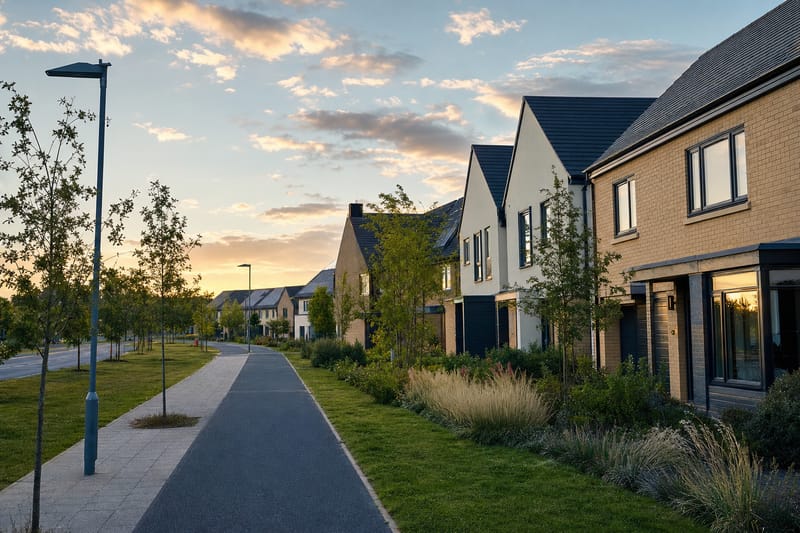
Milton Keynes has been building new homes continuously since it was designated a new town in 1967, and as of 2026 it remains one of the busiest new build markets in the South East and the wider Home Counties commuter belt. Unlike most UK towns, where new build supply is scattered across a handful of edge-of-town sites, Milton Keynes was master-planned from the outset with a grid of dual carriageways, dedicated cycle and footpaths (the "redways"), and reserved parcels of land for future growth — which is exactly why development here hasn't stopped for nearly 60 years.
If you're weighing up new build homes in Milton Keynes, the practical question isn't really "should I buy here" — the town scores well on affordability relative to London, road and rail connectivity, and green space — but "which part of Milton Keynes suits my budget, commute and lifestyle". The town is genuinely not one neighbourhood; it's a federation of over 30 distinct grid squares and estates, each with its own character, price band and stage of maturity, from long-settled 1990s districts to construction sites still selling off-plan in 2026.
This guide walks through the main new build growth areas — including Broughton, Brooklands, Kingsmoor Park, Whitehouse, Oakgrove, Salden Chase and Newton Leys — alongside realistic price bands, commuting times, and the specific things to check before you reserve a plot in a town that is, by design, still being built.
Why Milton Keynes Keeps Building: The Grid Road Master Plan
Understanding Milton Keynes' layout helps explain why new build supply here is so plentiful and so geographically spread out. The town is built on a one-kilometre grid of numbered dual carriageways — the "H" roads running roughly east–west and "V" roads running roughly north–south — with housing estates, business parks and local centres filling the squares in between. This was deliberate 1970s new-town planning by the Milton Keynes Development Corporation, designed to keep traffic flowing on the grid while residential streets inside each square stay quieter.
Running alongside and beneath the grid roads is the redway network: over 270 kilometres of segregated cycle and footpaths that let you walk or cycle between estates, schools, shopping centres and Central Milton Keynes without crossing a single main road. For families and buyers of any age wanting safer, car-optional routes to school or the station, this is one of Milton Keynes' genuine structural advantages over conventional new build estates bolted onto older towns.
- Grid squares: each roughly 1km x 1km, containing a mix of housing, local shops, schools and often a small park or lake.
- Redways: a continuous, largely traffic-free cycling and walking network linking most residential areas to Central Milton Keynes.
- Parks and green space: Milton Keynes was planned with extensive tree planting and parkland, including Willen Lake, Campbell Park and the Ouse Valley Park, and new developments typically continue this pattern with dedicated green corridors.
- Continuing expansion: because the original masterplan reserved land for growth, Milton Keynes City Council (and Milton Keynes Development Partnership successors) have kept releasing new parcels — which is why the town has active new build sites in most decades since the 1970s.
The grid and redway structure means a new build's exact grid square matters almost as much as which developer built it — two developments a few hundred metres apart can feel very different depending on which square, local centre and school catchment they sit in.
For buyers used to conventional towns, it's worth spending time with a map before viewing: Milton Keynes addresses can look confusing (numbered "V" and "H" roads, similarly named districts) until you understand the grid logic.
The Main New Build Growth Areas in Milton Keynes
New build activity in Milton Keynes tends to cluster in a rolling set of "growth areas" — large-scale allocated sites that get built out by several developers over a decade or more, rather than single estates finished in a year or two. As of 2026, the following are among the most active:
Western Expansion Area: Salden Chase, Shenley Park and Tattenhoe Park
West of the M1 and stretching towards Buckingham, this is one of Milton Keynes' largest ongoing allocations, delivering thousands of homes across several linked estates. It's popular with buyers who want new-build specification with easy access to the A421 and M1 Junction 13, and reasonably quick redway or bus links into Central Milton Keynes and the station.
Whitehouse and Oakgrove (North Central)
Whitehouse sits close to Central Milton Keynes and has been building out steadily, offering some of the shorter commutes to the station and city centre by bike or car. Oakgrove, further north-east, combines new housing with a purpose-built secondary school and local centre — a pattern typical of MK's approach to phasing infrastructure alongside rather than after housing.
Broughton and Brooklands (East)
Broughton is a long-running growth area east of the M1, now largely mature but still with pockets of newer phases and infill. Brooklands, immediately south, has been one of the more recently completed large sites, known for its lake and green space alongside several thousand new homes delivered by a mix of national housebuilders.
Kingsmoor Park and the Eastern Fringe
Newer allocations towards the eastern edge of the city continue the pattern of grid-square development, typically offering slightly larger plots and lower density than the most central squares, at the cost of a longer commute to the station.
Newton Leys (South)
Technically straddling the Milton Keynes and Aylesbury Vale boundary, Newton Leys has delivered a large number of new homes with lake-side green space, popular with buyers prioritising the A421/A5 corridor and Bletchley's rail connections over Central Milton Keynes proximity.
| Growth area | General location | Typical stage (2026) | Commute character |
|---|---|---|---|
| Salden Chase / Shenley Park / Tattenhoe Park | West, near M1 J13 | Active build-out, multiple phases | Car-strong; redway/bus to centre |
| Whitehouse / Oakgrove | North central | Later phases, largely established | Short cycle/drive to station |
| Broughton / Brooklands | East, near M1 J14 | Mostly complete, some infill | Moderate drive/cycle to centre |
| Kingsmoor Park & eastern fringe | Far east | Newer allocations | Longer drive to station |
| Newton Leys | South, near Bletchley | Largely built, some plots remain | Closer to Bletchley station |
Always check the current masterplan and remaining phases directly with the developer or on the developments section, since build-out stage shifts year to year as later phases release.
Milton Keynes New Build Property Prices by Area
Milton Keynes new build pricing sits below much of the wider South East and well below London, which is a core part of its appeal, but there's real variation between grid squares. As of 2026, treat the figures below as a broad guide only — always check current asking prices for the specific development and plot, since incentives, help-to-buy style schemes, and Stamp Duty Land Tax thresholds all move.
| Property type | Typical MK new build price band (2026, indicative) | Where you'll typically find it |
|---|---|---|
| 1-2 bed apartments | £180,000–£260,000 | Central Milton Keynes, Fenny Stratford, Oakgrove |
| 2 bed terraced/semi houses | £260,000–£340,000 | Broughton, Kingsmoor Park, Newton Leys |
| 3 bed semi/detached houses | £330,000–£430,000 | Brooklands, Whitehouse, Salden Chase |
| 4-5 bed detached houses | £430,000–£600,000+ | Shenley Park, Tattenhoe Park, western fringe |
A few pricing patterns worth knowing before you view:
- Plot position premiums: corner plots, those backing onto parkland or a redway (rather than a road), and plots near a lake typically carry a premium of several thousand pounds over a standard mid-terrace equivalent.
- Phase pricing: on multi-phase sites, later releases are often priced higher than earlier ones as the estate matures and amenities complete — buying early can mean a lower price but a longer wait for shops, schools and landscaping to finish.
- Service charges: many MK new build estates include shared green space, SUDS ponds and play areas maintained by an estate management company, adding an annual charge on top of council tax — factor this into your monthly budget, not just the purchase price.
- Help with affordability: some sites offer Shared Ownership or Deposit Unlock-backed plots; if you're using a Lifetime ISA for your deposit, check the property price cap still applies at your target development.
Because Milton Keynes has so much active supply, it's also a market where comparing multiple developments side by side genuinely pays off — use the site's compare tool to line up price, specification and completion dates before committing to a reservation fee.
Commuting from Milton Keynes: Rail, Road and the M1 Corridor
Milton Keynes' commuter credentials are a major reason it draws buyers relocating from London and the wider South East, and they vary meaningfully depending on which grid square you buy in.
Rail to London Euston
Milton Keynes Central station sits on the West Coast Main Line, with fast services to London Euston typically taking around 30–40 minutes depending on the operator and time of day — check current timetables, as off-peak and peak journey times and frequencies can differ, and always verify with the live National Rail timetable rather than a headline "fastest ever" figure. Bletchley station, on the southern edge of town, offers slower but useful links and sits closer to the Newton Leys growth area.
East West Rail
The reopening East West Rail line is a genuinely significant factor in Milton Keynes' new build growth: as of 2026 it is progressively connecting Oxford, Bicester, Milton Keynes/Bletchley, Bedford and eventually Cambridge, opening up cross-country commuting options that didn't exist for decades. Buyers considering longer-term value should check the current construction and service timetable for this line, since it directly affects several eastern and southern MK growth areas.
Road connections
Milton Keynes sits directly on the M1, with junctions 13 and 14 serving the western and eastern sides of the town respectively, plus the A5 and A421 for cross-country routes. This makes it a strong choice for hybrid or fully car-based commuters heading to Luton, Northampton, Oxford or the wider logistics and business corridor along the M1.
| Destination | Typical journey (indicative, check current timetables) | Mode |
|---|---|---|
| London Euston | ~30–40 minutes | Fast rail from MK Central |
| Birmingham New Street | ~50–60 minutes | Rail |
| Oxford (via East West Rail) | Improving as line completes phases | Rail |
| Luton / Luton Airport | ~30–40 minutes | M1 |
| Northampton | ~25–35 minutes | M1/A road |
If your commute is the deciding factor in where to buy, our broader guide to new build homes near major commuter rail links is worth reading alongside this one, since the same principles — walking distance to the station versus a drive-and-park routine — apply directly to choosing between MK's growth areas.
Schools, Amenities and Everyday Life on New Build Estates
Milton Keynes' development corporation model means schools, shops and health centres are typically planned alongside housing rather than arriving years later — but on active growth areas, the order in which they open still matters to daily life, especially in the first two or three years of an estate.
Schools
New growth areas usually have a primary school allocated within the masterplan, sometimes opening a year or two after the first homes complete. Secondary provision is more concentrated — Oakgrove, for example, includes an all-through school — so check current catchment arrangements and whether a secondary place is guaranteed or oversubscribed for your specific address, since catchments in fast-growing areas can shift as new schools open.
Local centres and shopping
Each grid square is generally designed around a small local centre (a parade of shops, a pub or community building), while larger retail needs are served by Central Milton Keynes' intu/Midsummer Place shopping centre and retail parks along the grid roads. On brand-new phases, it's common for the local centre to complete after the housing — worth asking the site sales team directly what's confirmed versus aspirational.
Healthcare and GP capacity
As with many fast-growing new build areas nationally, GP surgery capacity can lag population growth in the newest estates. Ask the local Integrated Care Board or check NHS surgery registration lists for the postcode before assuming a GP practice will have space when you move in.
Green space and leisure
Milton Keynes' parkland network is a genuine differentiator — Willen Lake, Campbell Park, the canal towpath and extensive woodland (much of it planted specifically as part of the original masterplan) give most new build estates walkable access to substantial green space, something older, denser towns often can't match.
- Check which primary school is the actual designated catchment for the specific plot, not just "nearby".
- Ask when the local centre (shops, GP, pub) is contractually due to open, and what happens if it slips.
- Look at redway connectivity on a map — some newer squares aren't fully linked to the wider network until later phases complete.
- Visit on a weekday evening and a Saturday to see the estate at different times, not just during a sales appointment.
Which Developers Build in Milton Keynes
Because Milton Keynes' growth areas are large, they're typically parcelled out to several housebuilders working side by side on the same masterplan rather than one developer building an entire district. This is useful for buyers, since it means genuine choice of specification and price within a five-minute walk, but it also means the same road can have quite different build quality, warranty provider and service charge arrangements depending on which plot you're looking at.
National housebuilders and volume developers active across Milton Keynes' growth areas in recent years have included names such as Barratt, David Wilson Homes, Bellway, Taylor Wimpey, Vistry (Bovis/Linden brands), Persimmon, and Crest Nicholson, alongside smaller regional builders on individual phases. Always confirm which specific developer and brand is building the plot you're interested in directly, since housebuilder groups frequently operate under several trading names on the same site.
On a single Milton Keynes growth area you may find three or four different developers building simultaneously — comparing their NHBC/LABC warranty terms, specification and HBF star ratings side by side is worth the extra half-day of research.
What to compare between developers on the same growth area
- Warranty provider: NHBC, LABC and Premier Guarantee are the main 10-year structural warranty providers used across UK new builds — confirm which applies and read the cover summary, not just the marketing brochure.
- HBF star rating: the annual Home Builders Federation customer satisfaction survey gives each major builder a star rating; our guide on using the HBF star rating to compare new build developers explains how to read it properly.
- Specification as standard vs. optional extras: flooring, turfed rear gardens, driveways and appliances vary significantly between builders even at similar price points.
- Build programme and completion reliability: ask for the site's actual track record on handing over on the promised date, not just the headline build time.
- Management company and estate charges: get the actual annual estate charge in writing, and ask what it covers, before you reserve.
Use the builders directory to check company-wide reputation and current ratings, and cross-reference with individual developments listings for the specific Milton Keynes site you're considering.
Flood Risk, Drainage and Milton Keynes' Balancing Lakes
Milton Keynes' distinctive lakes — Willen Lake, Caldecotte Lake, Furzton Lake and others — aren't purely amenity features; many originated as balancing lakes built into the original 1970s drainage masterplan to manage surface water across the grid. This history is generally a point in Milton Keynes' favour on flood risk compared with towns that have retrofitted drainage into older street patterns, but it doesn't mean every new build plot is automatically low risk.
On newer growth areas, sustainable drainage systems (SUDS) — attenuation ponds, swales and permeable paving — are now standard requirements from the Environment Agency and Lead Local Flood Authority as part of planning conditions. These features are often visible on site plans as green corridors or ornamental ponds within the estate.
- Check the government's long-term flood risk maps for the specific postcode, not just the borough-wide reputation.
- Ask whether the plot sits near a SUDS pond or swale, and get the developer's written confirmation of the surface water management scheme for that phase.
- Confirm which body maintains the SUDS features long-term — often the site's estate management company, which affects your service charge.
- Newer growth areas on the western and eastern fringes, built on greenfield land, may have different underlying groundwater and clay conditions to established squares nearer the original 1970s core — ask your conveyancer to review the site investigation reports.
For a full checklist of what to ask and where to check official flood data before reserving, see our guide on buying a new build in a flood risk area — the principles apply directly to Milton Keynes' lake-adjacent estates such as Brooklands, Caldecotte and Willen.
Choosing the Right Milton Keynes Growth Area for Your Situation
Milton Keynes doesn't have a single "best" new build area — it has several distinct answers depending on what you're optimising for. The table below is a starting point for narrowing down your search before you begin viewing.
| Buyer priority | Growth areas to focus on | Trade-off to accept |
|---|---|---|
| Fastest commute to MK Central station | Whitehouse, Oakgrove, Central Milton Keynes apartments | Higher price per square foot, less garden space |
| Largest house for budget | Shenley Park, Tattenhoe Park, Kingsmoor Park | Longer drive/cycle to the station and centre |
| Access to East West Rail / Bletchley | Newton Leys, southern fringe | Further from Central MK amenities |
| Established amenities from day one | Broughton, Brooklands (later phases) | Less choice of remaining plots, higher resale-influenced pricing |
| M1 commuting (Luton, Northampton, Birmingham) | Western Expansion Area near J13, Kingsmoor near J14 | Road noise consideration on plots near the grid roads |
| Lowest entry price | Apartments in Central MK, Fenny Stratford, early-phase eastern fringe | Smaller footprint, potential leasehold/service charge complexity |
A practical approach many buyers use: shortlist two or three growth areas based on commute and budget, then compare specific live developments within them using the site's properties search and map tool to see exactly how far each plot sits from the station, motorway junction, and nearest school — distances that can look similar on a brochure but feel very different on the ground given the grid road layout.
Because Milton Keynes is built on a repeating grid, "5 minutes from the station" can mean very different things depending on whether that's by redway bike route, by car via the grid roads, or as the crow flies — always check the actual route, not just the straight-line distance.
Investment and Rental Potential in Milton Keynes New Builds
Milton Keynes has a track record of attracting both owner-occupiers and buy-to-let investors, driven by continued population growth, a large employment base (logistics, tech, the relocated National Rail and various head offices), and strong graduate retention from The Open University and nearby university towns. As with any investment decision, treat historic price growth as context rather than a guarantee — check current data before committing.
Rental demand drivers
- A large working-age population commuting to London, Oxford, Cambridge and Birmingham via the improving rail network.
- Significant local employment in logistics and distribution along the M1 corridor.
- Ongoing population growth from the town's continued housing allocation, supporting steady rental demand for both houses and apartments.
Considerations specific to new build investment here
- Estate charges eat into yield: factor the annual management/service charge into your net yield calculation, not just gross rent versus purchase price.
- New-build premium on resale: new builds typically carry a price premium over equivalent second-hand stock; check comparable resale prices for similar-aged homes in the same grid square before assuming automatic capital growth.
- Phasing risk: buying early in a large multi-phase site can mean years of ongoing construction noise and dust nearby, which can affect rental appeal and short-term valuations even if the finished estate performs well long-term.
- Leasehold apartments: Central Milton Keynes and some newer apartment schemes are leasehold with ground rent and service charge structures — read the lease terms carefully, including any ground rent escalation clauses, before buying to let.
If you're weighing new build against established stock for investment purposes generally, our piece on energy cost savings comparing new build and older homes is a useful companion, since running costs affect both owner-occupier affordability and tenant demand.
What to Check Before You Reserve a Plot in Milton Keynes
Milton Keynes' scale and ongoing construction mean the standard new build due diligence checklist needs a few local additions before you pay a reservation fee.
Site-specific checks
- Remaining build-out timeline: ask how many further phases and years of construction remain on the wider growth area — you may be moving in years before the estate is fully finished.
- Redway connectivity: walk or cycle the actual route from the plot to the nearest school, local centre and station before assuming the brochure map reflects a completed network.
- Grid road noise and access: plots near the "H" and "V" grid roads can experience more traffic noise; ask about acoustic glazing specification if this applies.
- Estate management charge in writing: get the current annual figure, what it covers, and how it can be increased, before exchange.
- School place confirmation: contact Milton Keynes City Council's school admissions team directly for the current catchment position for the specific address, rather than relying on a sales brochure map.
Standard new build checks that still apply
- Confirm which 10-year warranty provider (NHBC, LABC, Premier Guarantee) covers the specific plot, and read what's actually covered.
- Budget realistically for solicitor fees — see our guide on new build solicitor fees and how to budget for them — since new build conveyancing typically involves more searches and additional legal checks than a resale purchase.
- Understand the exchange-to-completion process and any long-stop date in your reservation agreement; our guide on exchange to completion for first-time buyers covers this in detail.
- Get an independent snagging inspection before and shortly after legal completion, and understand what counts as normal settlement versus a genuine defect — see our explainer on plaster cracks and snagging for a common example.
- If buying via Shared Ownership, check the specific eligibility and staircasing terms for the Milton Keynes site against our Shared Ownership mortgages guide.
A reservation fee on a Milton Keynes new build typically locks in a price for a set period (commonly 28 days) while you arrange your mortgage and solicitor — use that window to complete these checks rather than treating reservation as a formality.
Frequently Asked Questions
Is Milton Keynes a good place to buy a new build home?
For many buyers, yes — it offers new build prices typically below much of the wider South East, a fast rail link to London Euston, extensive green space and a purpose-built cycle network. Whether it's right for you depends on which growth area, commute pattern and budget you're working with, which is why comparing specific developments matters more than a general reputation.
How long does it take to commute from Milton Keynes to London?
Fast services from Milton Keynes Central to London Euston typically take around 30–40 minutes, though this varies by time of day and operator — always check current live timetables rather than relying on a headline figure, and factor in the walk or drive to the station from your specific grid square.
What is the best area of Milton Keynes for new build houses?
There isn't a single best area — it depends on priorities. Whitehouse and Oakgrove suit those wanting proximity to the station and centre; Shenley Park and Tattenhoe Park suit buyers wanting more house for their budget with a car-based commute; Newton Leys suits those prioritising the southern rail links and East West Rail corridor.
Are Milton Keynes new build estates affected by flood risk?
Milton Keynes' extensive network of balancing lakes was built into the original 1970s masterplan specifically to manage surface water, and newer sites include SUDS features as standard planning requirements. This generally supports a reasonable flood risk profile, but you should still check the current Environment Agency flood maps for the specific postcode before reserving.
Do Milton Keynes new build estates have service charges?
Many do, since shared green space, SUDS ponds and play areas are typically maintained by an estate management company rather than the council. Always get the current annual charge and what it covers in writing before exchange, as it affects your real monthly cost beyond the mortgage.
Which developers build new homes in Milton Keynes?
A range of national housebuilders operate across Milton Keynes' growth areas, often several on the same site simultaneously, including names such as Barratt, David Wilson Homes, Bellway, Taylor Wimpey, Vistry brands, Persimmon and Crest Nicholson. Always confirm the specific developer and brand building your plot, and check their current HBF star rating and warranty provider.
Is Milton Keynes still building new homes in 2026?
Yes — Milton Keynes' local plan continues to allocate significant further housing across western, eastern and southern growth areas through the 2030s, meaning new build supply is likely to remain plentiful for some years, though specific site availability changes regularly.
Is Milton Keynes good for renting out a new build as an investment?
It has structural demand drivers — a large commuter and logistics workforce and continued population growth — but investors should factor in service charges, the new-build resale premium, and ongoing construction on multi-phase sites when calculating realistic net yield, rather than relying on gross rent figures alone.
Next Steps
Milton Keynes' scale means the best way to narrow down your search is to compare specific live developments rather than relying on general area reputation alone.
- Browse current developments across Milton Keynes' growth areas to see which phases are actively selling.
- Search individual properties by price, bedroom count and grid square.
- Use the map tool to check actual distances from a shortlisted plot to the station, motorway junction and nearest school via real routes, not straight lines.
- Check developer track records and current ratings in the builders directory before reserving.
- Use compare to line up two or three shortlisted developments side by side on price, specification, warranty and completion date.
- Explore the wider tools section for mortgage, affordability and Stamp Duty calculators to sense-check your budget against Milton Keynes' current price bands.
Milton Keynes rewards buyers who do the legwork on location within the town, not just on the town itself — the grid square, phase, and management arrangements of a specific plot can matter as much as the headline commute time or price band.