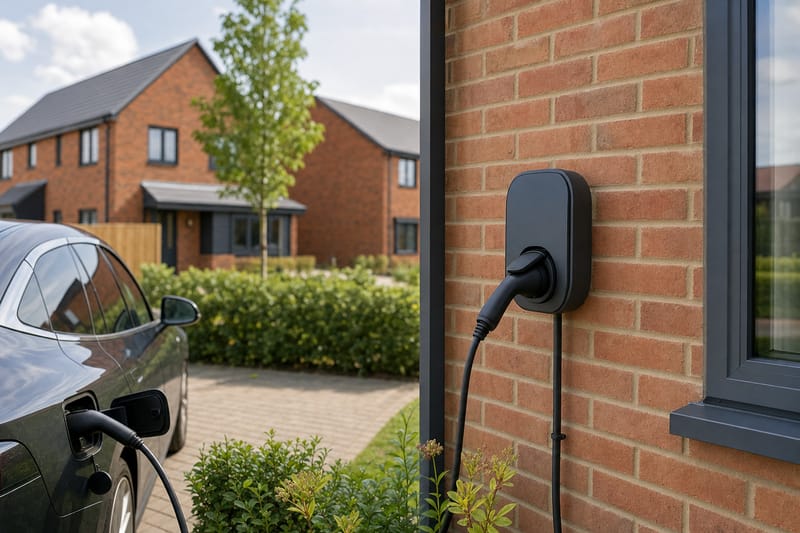
If you are buying or have recently moved into a new build, an EV charger is one of the few pieces of home infrastructure where the rules have changed faster than most buyers realise. Since June 2022, England's Building Regulations (Part S) have required most new homes with associated parking to be built with EV charging infrastructure — either a fully working charge point or, in some cases, the cabling and capacity to add one easily. Scotland and Wales have their own, broadly similar, requirements. That means many new build owners already have a charger on the wall, while others have a "charger-ready" supply that still needs a final fitting, and a smaller number have neither and need to arrange a full retrofit.
This guide walks through all three scenarios: how to work out which one applies to your home, what a retrofit installation actually involves, how much it typically costs in 2026, which grants are still live, and the planning permission and electrical safety rules you need to understand before anyone drills a hole in your wall or digs up your driveway.
Whether you're reading this before reserving a plot, during snagging, or a year or two after moving in and wondering why there's an odd cable stub in the garage wall, the principles here apply across England, Scotland, Wales and Northern Ireland, with notes on where the rules diverge. If you haven't already read our Essential Technology and Utilities Checklist for Your New Build Home, it's a useful companion piece for everything else in the utility cupboard besides the charger.
What New Builds Are Required to Have Now
Part S of the Building Regulations ("Infrastructure for the charging of electric vehicles") applies to new residential buildings in England with associated parking, and sets out three broad categories of compliance. Developers can meet the requirement in different ways depending on plot type, so it's worth knowing which applies to your home before you assume anything is missing.
- A fully functioning charge point — the most common outcome for houses with a driveway or garage. A 7kW (sometimes 22kW on larger plots with three-phase supply) smart charger is fitted and commissioned before handover, usually mounted on the house wall or a nearby post.
- Cable routing ("ducting") only — some developments, particularly flats and apartment blocks with communal parking, install underground ducting and a dedicated electrical capacity allowance to each space, but leave the final charger to be fitted when a resident actually buys an EV. This keeps costs down for the developer and avoids installing chargers that may sit unused for years.
- No charger and no provision — this can legitimately happen where a plot has no associated parking (some town centre schemes, conversions, or developments predating the regulation), or where a very small number of exemptions apply, such as certain minor developments or specific listed building constraints.
Scotland's equivalent standard sits within the Scottish Building Standards technical handbooks, and Wales applies its own Building Regulations approach, both broadly mirroring the England position but with different implementation dates and thresholds — always check the current position for the nation you're buying in rather than assuming England's rules apply UK-wide.
Don't assume "new build" automatically means "charger fitted." The regulation is about infrastructure, not always a finished, usable charge point — ducting-only compliance is common on apartment schemes and some townhouse plots.
It's also worth checking your original reservation documents and the development's technical specification, which should state explicitly whether a charge point is included, what brand and rating it is, and whether it was a standard inclusion or a paid-for optional extra at the point of sale. Developers increasingly list EV charging as a selling point in their marketing, so the information is usually easy to find if you still have your sales pack.
How to Check What Your Home Already Has
Before you call an installer or budget for a retrofit, spend 20 minutes confirming exactly what's already in place. It's surprisingly common for owners to pay for a full installation only to discover later that a supply was already provisioned.
Walk the obvious locations
- Garage and driveway walls — look for a small weatherproof cabinet or socket, often grey or black, close to where a car would park. It may be covered with a blanking plate if not yet commissioned.
- Consumer unit (fuse box) — open the cover (don't touch anything if unsure) and look for a spare, labelled way or a breaker marked "EV" or "EVSE". A ready-but-uncommissioned supply often has cable already run and capped off near the consumer unit.
- Meter cupboard — some developers fit a separate meter or sub-meter for EV charging, particularly where a time-of-use export or off-peak tariff arrangement is anticipated.
Check your paperwork
- The home user guide / handover pack given at legal completion should list all installed systems, including any EV charger make, model and warranty.
- The electrical installation certificate (EIC) issued by the electrician who wired the house will show what was tested and signed off, including any EV charging circuit.
- Your NHBC, LABC or Premier Guarantee warranty documents may reference the charger as part of the covered electrical installation.
If nothing is visible and your paperwork is silent on the matter, contact your developer's customer care team directly and ask explicitly whether Part S (or the Scottish/Welsh equivalent) compliance was met through ducting, a fitted charger, or an exemption. Get the answer in writing — it matters for both your retrofit planning and any warranty claim down the line.
If There's No Charger: What a Retrofit Installation Involves
If your new build has no charger, no ducting and no spare capacity flagged, you're in the same position as any homeowner adding a charger to an existing property. The process is well established and typically runs over four stages.
- Site survey — an installer assesses your consumer unit's spare capacity, the distance and route from the consumer unit to the proposed charger location, your earthing arrangement, and whether your main fuse and supply can handle the extra load alongside existing appliances.
- Quotation and design — you'll get a fixed quote covering the unit, cabling, any groundworks (for driveway-mounted posts or where cable must be run underground to a garage), and commissioning.
- Installation — usually completed in a single day for a straightforward wall-mounted charger close to the consumer unit; longer if cable runs are extensive or groundworks are needed.
- Commissioning, certification and DNO notification — the installer tests the circuit, issues an Electrical Installation Certificate, and notifies your electricity Distribution Network Operator (DNO) where required under Engineering Recommendation G98/G99, since EV chargers are classed as a significant new load.
Key technical checks an installer must make
| Check | Why it matters |
|---|---|
| Consumer unit spare capacity | A 7kW charger draws roughly 32A continuously — your board needs a free way and adequate overall capacity |
| Main fuse rating | Older or smaller 60A/80A supplies may need an upgrade request to the DNO before a 7kW charger can be added safely |
| Earthing arrangement (PME vs TT) | Homes on a PME (TN-C-S) supply need an approved open-PEN fault protection device built into the charger under BS 7671 regulations |
| Cable route and distance | Longer runs increase voltage drop risk and installation cost; underground routes need ducting and reinstatement |
| RCD/RCBO protection | A dedicated circuit with Type A or Type B RCD protection is required depending on charger design |
On most modern new builds the consumer unit has reasonable spare capacity because developers anticipate higher electrical loads (heat pumps, induction hobs, EV charging), but it's never safe to assume — always get a qualified assessment rather than fitting a charger to an unchecked supply.
Planning Permission: What's Actually Required
Most domestic EV charger installations fall under permitted development rights in England, Scotland and Wales, meaning you don't need to apply for planning permission. However, "most" is doing some work in that sentence, and new build estates in particular can trip up a few of the standard exemptions.
When permitted development normally applies
- The charger unit is no higher than 2.3 metres on a wall or post below 1.6kW output limits don't actually apply to chargers — the relevant conditions concern height and position relative to a highway.
- It is not installed within 2 metres of a highway if mounted higher than 2 metres (rarely relevant to standard wall boxes).
- The property is a house, not installed on or adjacent to a listed building, and not within the curtilage of a scheduled monument.
When you need to check further
- Flats and maisonettes — permitted development rights for EV chargers generally apply to dwelling houses, not flats. If you own a flat on a new build scheme, charger installation on communal land or a shared parking area usually needs freeholder or management company consent rather than full planning permission, but it's a different process to a house.
- Article 4 directions — a small number of local authorities restrict permitted development rights in specific areas (conservation areas, some new build estates with design covenants). Check with your local planning authority or your developer's estate management documentation.
- Listed buildings and conservation areas — rare for new builds, but relevant if your development sits within a wider conservation area or includes converted heritage buildings.
If your estate has a management company overseeing shared roads, visitor parking or landscaping (common on larger new build schemes), check your estate deed of covenant or transfer document too — some include clauses requiring notification or consent before external alterations, even where no formal planning permission is needed. This is a similar consideration to the rules covered in our guide on New Build Aerials and Satellite Dishes: What Your Estate Allows.
Consumer Unit Capacity and Electrical Safety Rules
EV chargers are among the heaviest continuous electrical loads in a typical home, so the wiring rules around them are more detailed than for most other appliances. Every installation in the UK must comply with BS 7671 (the IET Wiring Regulations) and, since 2019, with additional requirements specifically covering EV charge points.
What a competent installer checks and provides
- Dedicated circuit — your charger must be wired on its own circuit back to the consumer unit, not shared with sockets or lighting circuits.
- RCD protection — either built into the charger unit itself (most modern smart chargers include this) or provided at the consumer unit.
- PME earthing fault protection — if your home is on a PME (Protective Multiple Earthing) supply, which most new builds are, the installer must fit a device that disconnects the charger in the rare event of an open-PEN fault, to prevent your car (and anyone touching it) becoming electrically live.
- Load management or diversity — some installers fit a load-balancing device that reduces charger output automatically if your overall household demand spikes, avoiding the need for a full supply upgrade in borderline cases.
Smart charging requirements
Since 2022, new domestic chargers sold and installed in Great Britain must meet the Electric Vehicles (Smart Charge Points) Regulations, meaning they default to off-peak charging unless you override it, and include safety and cyber-security features. This isn't something you need to manage directly — any compliant unit from a reputable installer will already meet the standard — but it's worth asking your installer to confirm compliance in writing, since it also affects your eligibility for some energy tariffs designed around EV charging.
| Supply type | Typical on new builds? | Extra requirement |
|---|---|---|
| PME (TN-C-S) | Yes, most common | Open-PEN protection device required in charger or installation |
| TT (earth rod) | Occasionally, especially rural plots | RCD protection, generally simpler installation |
| Three-phase supply | Some larger detached new builds | Enables faster 11kW/22kW charging if the vehicle supports it |
Always ask for a copy of the Electrical Installation Certificate after any work, and keep it with your home file alongside your NHBC or warranty documents — you'll need it if you sell the property, and most conveyancing solicitors now ask specifically whether any EV charger installation has the correct certification.
What a Retrofit Installation Typically Costs in 2026
Costs vary by charger brand, installation complexity, cable run length and whether any groundworks or consumer unit upgrade is needed. The figures below are typical UK ranges as of 2026 — always get at least two or three fixed quotes, since prices vary meaningfully by region and installer.
| Installation type | Typical cost range | Notes |
|---|---|---|
| Basic wall-mounted 7kW charger, short cable run, spare capacity already available | £800–£1,300 | Most common scenario where ducting/provision already exists |
| Standard retrofit, new circuit from consumer unit, moderate cable run | £1,000–£1,800 | Typical for a house with no prior EV provision |
| Driveway post-mounted charger with underground cable run | £1,500–£2,500 | Includes trenching and reinstatement of block paving or lawn |
| Consumer unit upgrade or main fuse increase required | Add £300–£800 | Needed if existing board lacks capacity or spare ways |
| 22kW charger with three-phase supply | £1,800–£3,000+ | Only relevant where a three-phase supply already exists |
Ongoing running costs are separate from installation. Most EV drivers see the biggest savings by charging on an EV-specific off-peak electricity tariff, which can bring overnight unit rates down substantially compared with a standard variable tariff — worth reviewing alongside your broader household energy setup, as covered in Setting Up Broadband, Media, and Tech in Your New Build for the utilities side of moving in.
Don't forget ongoing maintenance: a wallbox charger needs little upkeep, but periodic electrical testing (in line with your home's overall periodic inspection schedule) is sensible, particularly if the charger is outdoors and exposed to weather.
Grants and Schemes: What's Still Available in 2026
The government's original EV Homecharge Scheme (EVHS), which offered homeowners a grant towards charger installation, closed to most new applicants some years ago. However, several targeted schemes remain live or have replaced it, and eligibility depends heavily on your circumstances — always check the current position on GOV.UK before assuming a grant does or doesn't apply to you.
| Scheme | Who it's typically for | Status to check |
|---|---|---|
| EV Homecharge Scheme (EVHS) | Homeowners (historic) | Closed to most homeowners — confirm current status |
| EV Chargepoint Grant | Renters and flat owners without off-street parking rights, and some homeowners in flats | Check current eligibility criteria and funding cap |
| Workplace Charging Scheme | Employers installing chargers for staff/fleet use | Separate application route, not for individual homeowners |
| Local authority / devolved nation grants | Varies by council and nation (e.g. Scotland's separate EV grant schemes) | Check your local council and the Energy Saving Trust (administers Scotland's scheme) |
Because most new build homeowners have off-street parking (a driveway, garage or allocated space), they typically fall outside the current flats/rental-focused grant criteria — meaning most new build owners doing a retrofit in 2026 will be paying the full installation cost themselves, or via a VAT-reduced route where applicable. It's worth checking anyway, since criteria shift and some local schemes are specific to new developments with particular planning conditions attached.
Grant eligibility rules change frequently and are easy to get wrong. Always check the live criteria on GOV.UK or with the Energy Saving Trust directly rather than relying on older articles or installer marketing claims about "free" chargers.
Separately, some energy suppliers and car manufacturers run their own charger-bundling offers (for example, discounted installation when you buy or lease a specific EV model). These aren't government grants but can meaningfully reduce your net cost — just check the small print on tariff lock-in periods and whether the charger remains yours if you switch supplier later.
Choosing a Qualified Installer
Not every electrician is automatically qualified to install EV chargers to the required standard, and using an unqualified installer can affect both your safety and any future grant eligibility, insurance claim, or home sale. Look for the following before booking any work.
- OZEV-approved installer status (where relevant to a grant application) — required if you're claiming under any live government scheme.
- NICEIC, NAPIT or ECA registration — confirms the electrician is assessed against current wiring regulations and can self-certify work under the Competent Person Scheme, meaning Building Regulations notification is handled automatically.
- Specific EV charger installation training — general electrical competence doesn't automatically cover the specific earthing, load management and smart charging compliance requirements for EV circuits; ask whether the installer holds EV-specific City & Guilds or equivalent certification.
- Manufacturer approval — many charger brands (Ohme, Myenergi, Pod Point, EO, Hypervolt and others) only honour their product warranty if installed by an approved installer, so check this before choosing a unit.
Questions worth asking any quote
- Is the quote fixed, and does it include making good (patching walls, reinstating paving) after the work?
- Will you issue an Electrical Installation Certificate and notify Building Control or self-certify under a Competent Person Scheme?
- Does the charger meet the Smart Charge Points Regulations, and is it compatible with my intended energy tariff and app?
- What is the warranty period on the charger itself, separate from your installer's workmanship guarantee?
- Will the installation affect my ability to make a future NHBC or developer warranty claim on the wall or driveway surface it's fitted to?
For a wider view of what to check before and after any contractor visits your new build for additions or repairs, our How to Maintain Your New Build Warranty Coverage guide covers the documentation habits worth building early.
Does Your Developer's Electrical Warranty Cover a Retrofit?
This is one of the most commonly misunderstood areas for new build owners, and the honest answer is: it depends on what work is being done, and to what.
What's typically covered under your structural warranty
Your NHBC, LABC or Premier Guarantee warranty (or equivalent) covers defects in the original build — including the electrical installation as originally fitted — for a defined period, usually with a two-year builder warranty period followed by a longer structural cover period (commonly up to ten or twelve years in total, with electrical faults generally falling under the shorter window unless they relate to structural or major damp/water ingress issues). If your home came with a developer-fitted EV charger and it develops a genuine fault within the warranty period, that's generally a warranty or manufacturer issue, not something you pay for.
What a retrofit is not covered by
If you add a charger that wasn't part of the original build, the new installation itself is not covered by your NHBC or structural warranty — it's covered instead by the installer's own workmanship guarantee and the charger manufacturer's product warranty. This is standard and expected; it's the same principle that applies to any post-completion alteration, such as a conservatory, loft conversion or extension.
Where it gets more sensitive: warranty-affecting work
- Cutting into render, brickwork or cladding to run cable — done incorrectly, this can create a route for water ingress, which could affect a future warranty claim on that part of the building envelope. Always ask your installer how they'll route cable through external walls and what sealing method they'll use.
- Digging into the driveway or patio — if your driveway surface is itself covered under warranty for workmanship defects, reinstating it incorrectly after cable trenching could complicate a future claim if settlement or cracking occurs nearby.
- Consumer unit modifications — adding a new breaker or circuit to a developer-installed consumer unit is routine and shouldn't itself void cover, provided it's done by a competent, certified installer and properly documented.
A sensible rule: keep photographs and the Electrical Installation Certificate from any retrofit work, and if the installation involves cutting into the building's external envelope, tell your warranty provider so it's on record before any later claim could be disputed.
If in doubt, call your warranty provider's customer line before work starts and ask directly whether a specific type of EV charger installation affects your cover. It's a five-minute call that avoids a much longer argument later.
Flats, Shared Driveways and Management Company Rules
If your new build is a flat, maisonette, or a house on an estate with shared parking courts or private roads managed by a residents' management company, EV charger installation involves an extra layer of process that houses with their own driveway don't face.
Allocated parking bays on communal land
Even where you have an allocated parking space, the land itself may legally belong to the freeholder or management company rather than to you personally. Installing a charger here typically requires:
- Written consent from the freeholder or management company, which may have its own approved installer list or technical specification (cable routing, charger appearance, maximum output) to protect the look and electrical capacity of the wider scheme.
- Confirmation of how the electricity used will be billed — some schemes have the charger wired to the individual flat's supply via a sub-meter; others require a standalone supply and account, particularly where bays are some distance from the building.
- Checking your lease for specific clauses about alterations to demised or communal areas — many new build leases require landlord consent (not unreasonably withheld) for this kind of work.
Shared private roads
On estates where the road itself remains unadopted and privately managed (common in the early years of a new build phase before adoption by the local authority), underground cable routes crossing that road for a driveway charger may need the management company's agreement, even for houses with their own driveway. Check your estate's transfer documents or speak to the management company before any trenching work begins.
| Property type | Typical consent needed | Key document to check |
|---|---|---|
| House, own driveway, adopted road | Usually none beyond permitted development | Title deed, planning history |
| House, unadopted/private shared road | Management company agreement for any works crossing the road | Estate transfer / deed of covenant |
| Flat, allocated bay on communal land | Freeholder/management company consent, possibly lease variation | Lease, management company rules |
| Flat, no allocated parking | Charger installation likely impractical; check EV Chargepoint Grant eligibility | Lease, local parking permit scheme |
This overlaps with the kind of estate-wide rules covered in Parking and Transport on New Build Developments, which is worth reading alongside this section if you're on a managed estate.
Timeline: From Enquiry to a Working Charger
How long a charger installation takes depends heavily on which starting scenario applies to your home. The table below gives realistic ranges based on typical 2026 installer lead times, though regional demand and DNO response times can extend these.
| Scenario | Typical timeline | Main variables |
|---|---|---|
| Charger already fitted and working | Immediate | None — confirm app setup and tariff registration |
| Ducting/provision present, charger needs fitting | 1–3 weeks | Installer availability, charger stock |
| Standard retrofit, spare consumer unit capacity | 2–4 weeks | Survey-to-install lead time, installer diary |
| Retrofit requiring consumer unit or main fuse upgrade | 4–8 weeks | DNO notification/approval for supply upgrade under G98/G99 |
| Flat/communal bay requiring management company consent | 6–12 weeks+ | Management company response time, possible lease variation |
DNO notification is often the least predictable part of the process for larger loads. Most single 7kW domestic chargers are notifiable rather than requiring prior approval, meaning the installer tells the DNO after the fact and work can usually proceed without delay. However, if your installation requires a main fuse upgrade, or you're adding a charger alongside other new heavy loads (a heat pump, for example), the DNO may need to assess and approve the connection beforehand, which can take several weeks depending on local network capacity.
If you're planning ahead of a known EV purchase (for example, ordering a new car with a lead time of a few months), it's worth starting the installer conversation as soon as you have a delivery date, rather than waiting until the car arrives.
Frequently Asked Questions
Do all new build homes in the UK come with an EV charger fitted?
No. Since June 2022, most new homes in England with associated parking must include EV charging infrastructure under Part S of the Building Regulations, but this can mean a fully fitted charger, or simply ducting and spare electrical capacity ready for one to be added later. Check your handover paperwork or ask your developer's customer care team to confirm which applies to your plot.
Can I install an EV charger without planning permission?
In most cases, yes — EV charger installation on a house with its own driveway or garage generally falls under permitted development rights across England, Scotland and Wales. Flats, properties with communal parking, listed buildings, and some estates with Article 4 directions or restrictive covenants are the main exceptions where further consent may be needed.
Will fitting a charger void my NHBC or developer warranty?
A retrofit installation itself isn't covered by your structural warranty — it's covered by the installer's workmanship guarantee and the charger manufacturer's warranty instead. It generally won't void your existing structural warranty on the rest of the property, provided the work is done by a qualified, certified installer and doesn't damage the building envelope (render, cladding, driveway surface) in a way that causes a separate defect. Always check with your warranty provider before work involving cutting into external walls or driveways.
Is the OZEV grant still available for homeowners in 2026?
The original EV Homecharge Scheme (EVHS) for homeowners has closed to most applicants. The EV Chargepoint Grant and related schemes remain targeted mainly at renters, flat owners without dedicated off-street parking, and some specific circumstances — always check current eligibility on GOV.UK, since criteria and funding levels change periodically.
How much does it typically cost to retrofit an EV charger at a new build home?
A straightforward installation with existing spare consumer unit capacity typically costs £800–£1,800 as of 2026. Costs rise if groundworks, a consumer unit upgrade, or a longer cable run are needed, and can reach £2,500 or more for driveway post-mounted chargers requiring trenching.
What's the difference between a 7kW and 22kW charger, and does it matter for my new build?
A 7kW charger suits most single-phase domestic supplies and typically fully charges a family EV overnight. A 22kW charger needs a three-phase electricity supply, which only some larger new build homes have. Check your supply type with your installer before assuming a faster charger is an option.
Do I need to tell my electricity network operator (DNO) before installing a charger?
Most single domestic chargers are notifiable after installation rather than requiring prior approval, and a competent installer handles this as part of the job. If your installation needs a main fuse upgrade or coincides with other large new loads, prior DNO approval may be required, which can extend your installation timeline by several weeks.
Can I install a charger myself to save money?
No — EV charger installation involves dedicated circuit work, specific earthing protection and compliance with BS 7671 and the Smart Charge Points Regulations. It must be carried out and certified by a competent, registered electrician. DIY installation is both unsafe and likely to invalidate your home insurance and any product warranty.
Next Steps
Whether you're assessing a specific plot before reserving, or already living in your new build and planning a retrofit, a bit of groundwork before you book an installer saves time and money.
- Browse current developments if you're still choosing a plot, and ask the sales team specifically whether EV charging infrastructure is included or an optional extra.
- Check builders profiles to compare how different developers approach EV charging specification across their current sites.
- Search properties for listings that mention EV charger inclusion directly in the particulars.
- Use the map to check your development's location relative to public charging infrastructure, useful if you don't yet have off-street parking sorted.
- Explore our tools section for calculators and checklists that can help you budget for post-completion additions like an EV charger alongside your other moving-in costs.
- Use compare to weigh up different developments or plots side by side, including their electrical specification, before you commit.
If you're still at the research stage of buying, it's also worth reading our guide on What to Check on a Site Visit Before Reserving a New Build Plot, which covers the wider set of specification questions worth asking before you sign anything — EV charging infrastructure is just one line on a much longer list.
The single most useful thing you can do before booking any EV charger work is confirm, in writing, exactly what your home already has and what your warranty provider says about retrofitting — everything else follows from those two answers.