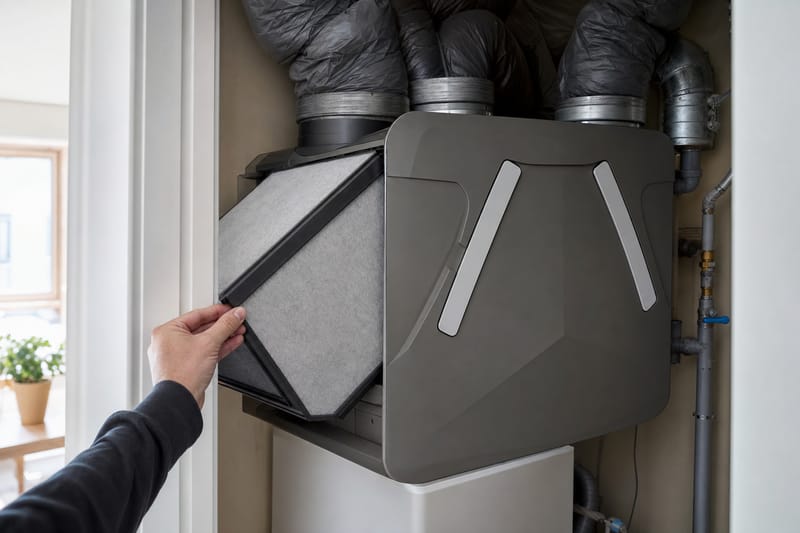
If you have bought (or are about to buy) a new build home, the energy performance certificate, the air test results and the sales brochure all made a point of how airtight the house is. What they probably did not mention in any detail is that an airtight home cannot simply be ventilated by opening a window and hoping for the best. It needs a mechanical ventilation system — either a full Mechanical Ventilation with Heat Recovery (MVHR) unit, or a simpler extract system of fans in the kitchen and bathrooms — running more or less continuously, and that system has filters, fans and ducts that need looking after.
This is where the budgeting gap usually appears. Solicitors' packs, mortgage illustrations and developer cost sheets cover stamp duty, service charges, warranty premiums and energy bills. Almost none of them mention that an MVHR system typically needs new filters once or twice a year at a cost of roughly £40–£120 a set, plus an occasional professional service, and that neglecting it can quietly undermine the air quality and energy efficiency the system was installed to deliver in the first place.
This guide sets out, in practical terms, what ventilation system your new build is likely to have, what it actually costs to keep it running properly, how the costs differ between MVHR and simpler extractor-fan-based systems, and what tends to go wrong — and get expensive — when the system is left untouched after the first year. It is written for buyers budgeting ahead of purchase and for owners who have just had their first filter-change reminder light up and want to know whether that is a £15 job or a £300 one.
For related running-cost planning, see our Year One Budget Guide: New Build Running Costs and How to Calculate True Monthly Costs of a New Build, both of which this article complements by focusing specifically on the ventilation line item that most budgets miss entirely.
What ventilation system does your new build actually have?
Not every new build has MVHR, and the maintenance picture is quite different depending on which system is fitted. Before you can budget sensibly, it helps to know which of the following your home has — check your Home User Guide, the mechanical and electrical specification in your sales pack, or simply look for a loft- or cupboard-mounted unit with ducting running to every room.
MVHR (Mechanical Ventilation with Heat Recovery)
A central unit, usually in the loft, airing cupboard or a utility room, continuously extracts stale, moist air from kitchens, bathrooms and utility rooms, passes it through a heat exchanger, and supplies fresh filtered air to bedrooms and living rooms. It is increasingly common in homes built to higher airtightness standards, particularly flats and highly insulated timber-frame or fabric-first developments, and is often how builders meet Part F and Part L building regulations without relying on trickle vents.
dMEV and MEV (Mechanical Extract Ventilation)
A simpler, cheaper-to-install system: individual continuously running extract fans in kitchens and bathrooms (dMEV, decentralised) or a single central extract unit pulling air from several wet rooms through ducting (MEV, centralised). Fresh air comes in passively through trickle vents in window frames rather than a heat-recovery unit. This is the most common system in standard volume-builder houses as of 2026.
Intermittent extractor fans
The simplest and oldest approach: a fan in the bathroom or kitchen that switches on with the light or a humidity sensor and switches off after a timed period, with background ventilation from trickle vents. Increasingly rare in new builds under current Part F guidance for whole-dwelling ventilation, but still found in some conversions, smaller developments, or older plots within a larger site.
| System | Typical dwelling | Main components | Maintenance burden |
|---|---|---|---|
| MVHR | Flats, fabric-first houses, higher-spec developments | Central unit, supply/extract ducting, two filter sets | Highest — filters, ducts, unit servicing |
| MEV/dMEV | Standard volume-builder houses | Extract fans, trickle vents | Moderate — fan filters/grilles, occasional fan replacement |
| Intermittent extract | Smaller developments, conversions | Bathroom/kitchen fans, trickle vents | Low — grille cleaning, fan replacement every several years |
If you are still choosing a plot, this is worth asking about directly at a site visit before reserving a new build plot, since the answer materially changes your ongoing running costs and the complexity of any future repairs.
MVHR filter replacement cost: what you should actually budget for
Most MVHR units use two filter grades: a coarser G3/G4 (or the newer ISO ePM10/ePM1 equivalent) filter on the extract side, catching dust and lint from indoor air, and a finer F7/F8-equivalent filter on the supply side, catching pollen and finer particulates from outside air before it reaches your bedrooms. Both need periodic replacement, and the supply filter is usually the more expensive of the two because it is doing finer filtration work.
Costs vary by brand — common manufacturers found in UK new builds include Vent-Axia, Nuaire, Zehnder, Titon and Envirovent — and by whether you buy genuine branded filters or compatible third-party equivalents.
| Item | Typical cost (pair/set) | Typical replacement interval |
|---|---|---|
| Coarse extract filter (G3/G4) | £15–£35 | Every 6–12 months |
| Fine supply filter (F7/F8) | £25–£60 | Every 6–12 months |
| Full filter set (both sides) | £40–£120 | Annually is typical; some manufacturers recommend twice a year in high-pollen or urban areas |
| Third-party/compatible filters | £20–£70 per set | Same interval, lower cost but check warranty implications |
Fitting filters yourself is straightforward on most units — a sliding tray or hinged flap gives access without tools in many cases — so the figures above are largely the whole cost if you do it yourself. Where people get caught out is assuming the filter light is optional: most MVHR units have an indicator (a light, a flashing LED pattern, or a smartphone app alert on newer smart units) that tells you when to change filters, and ignoring it for a year or two does not save money, it just moves the cost further down the line in the form of reduced airflow, more strain on the fan motor, and potentially higher electricity use as the unit works harder to pull air through a clogged filter.
Treat MVHR filters like a boiler service, not like a smoke-alarm battery: it is a predictable, recurring cost, not a one-off repair. Budgeting £60–£120 a year for filters alone is realistic for most single-family new build homes.
Flats on communal MVHR systems (where a single plant room serves multiple units, or each flat has its own small unit fed from shared risers) sometimes have filter costs folded into the service charge rather than paid individually — check your lease and the building's management agreement, as this is a common point of confusion covered further in our guide to understanding estate charges on new build developments.
MVHR servicing cost UK: when you need a professional
Changing filters is usually a DIY job. A full service — checking and balancing airflow rates, cleaning or inspecting the heat exchanger core, checking fan bearings and motor condition, inspecting ductwork for leaks or disconnections, and verifying the unit against the commissioning figures recorded when your home was built — is a different matter and typically needs a qualified ventilation engineer, particularly within the warranty period where DIY interference could affect a claim.
| Service type | Typical cost (2026) | Recommended frequency |
|---|---|---|
| Filter change only (DIY) | £40–£120 (parts only) | Every 6–12 months |
| Basic professional check and filter change | £80–£150 | Annually |
| Full service including airflow commissioning check | £150–£300 | Every 2–3 years, or at first sign of reduced performance |
| Heat exchanger core clean/replacement | £100–£400 | As needed, often 5–10 years |
| Fan motor replacement | £150–£450 parts and labour | Typically out of warranty, 8–15 year lifespan |
These figures are indicative and will vary by region, unit size, and whether the engineer needs to travel far to reach your development — always get a quote from a firm certified by a relevant body such as BPEC or an equivalent ventilation-specific qualification, and check whether your developer's aftercare team has a preferred contractor who already knows the system installed on your development, which can save a diagnostic visit.
During your first two years, most issues should be covered by the developer's defects period or the structural warranty provider (commonly NHBC, LABC or Premier Guarantee), so a genuine fault — as opposed to routine filter changes, which are an owner responsibility — should be reported through your developer's aftercare process rather than paid for out of pocket. We cover the boundary between what warranties do and do not cover in our guide to new build warranty costs and what they cover.
How often do filters actually need changing?
Manufacturer guidance generally says every 6–12 months, but the honest answer is that it depends heavily on where you live and what is around your home. Filters catch whatever is in the air being drawn in and extracted, so the following all shorten the realistic interval:
- Proximity to a busy road. Homes on or near arterial roads or close to a development's main access road draw in more particulate matter, clogging supply filters faster.
- Building works nearby. If you are an early occupier on a development that is still being built out, ongoing construction dust can clog filters within months rather than a year — it is worth checking filters more often during the first year or two of occupation on a phased site.
- Pets. Pet hair and dander significantly increase the load on extract-side filters, particularly in homes with cats or dogs that shed.
- Cooking habits. Frequent frying or grilling without a cooker hood on full extract sends more grease-laden air into the kitchen extract valve, which can affect the nearest ducting and filter faster than a household that cooks less, or extracts more diligently.
- High pollen seasons. Spring and early summer can clog fine supply filters faster in semi-rural or green-belt-adjacent developments.
A practical approach is to check filters visually every three months during year one — it takes a few minutes and costs nothing — and use that observation to set your own replacement schedule rather than relying blindly on the manufacturer's default interval or waiting for a warning light, which on some budget units is simply a fixed timer rather than an actual airflow or pressure sensor.
If you are unsure which filter grade your unit takes, the model number is usually printed on a label inside the unit casing or on the commissioning certificate left by the developer at handover — keep this document, since quoting the exact model to a filter supplier or spares website is the fastest way to get the right part at the lowest price rather than paying a premium for a generic "MVHR filter" search result.
Extractor fan maintenance new build: the simpler end of the spectrum
If your home has MEV, dMEV or standard intermittent extractor fans rather than full MVHR, your maintenance costs are lower but not zero, and the failure modes are different — usually noise, reduced extraction, or the fan simply stopping rather than a filter clogging silently in the loft.
Typical annual costs
- Grille and filter cleaning (DIY): Effectively free — most wet-room extract grilles unclip for a wash in warm soapy water every few months, and many dMEV units have a simple washable foam filter pad costing £5–£15 to replace every one to two years if not washable.
- Fan replacement: £60–£180 for parts plus £60–£120 labour if you use an electrician, typically needed only after 8–12 years depending on usage and build quality.
- Humidistat or timer fault: £40–£100 to diagnose and replace a faulty sensor or control board on a continuously running centralised MEV unit.
- Trickle vent cleaning: Free DIY task, but frequently neglected — dust and insect debris block the small slots, reducing the passive air intake these systems rely on.
Because MEV and dMEV systems have no heat exchanger core and far simpler ducting, there is less that can quietly degrade unnoticed compared with MVHR. The main risk with these systems is not cost but neglect of the basics: trickle vents painted shut during redecoration, extract grilles blocked by furniture or blinds, or fans switched off at an isolator because the continuous hum is mistaken for a fault rather than the system working as designed.
| Task | Frequency | Typical cost |
|---|---|---|
| Wash/vacuum extract grilles | Every 3–6 months | Free (DIY) |
| Replace washable/foam filter pad | 12–24 months | £5–£15 |
| Clean trickle vents | Every 6 months | Free (DIY) |
| Fan motor replacement | 8–12 years | £120–£300 fitted |
Overall, a household with MEV or standard extractor fans can reasonably budget £20–£60 a year on average once the fan-replacement cost is spread over its lifespan, substantially less than a full MVHR system, which is one of the trade-offs of the simpler specification common in standard volume-build houses.
Whole-house ventilation running costs: the electricity bill side
Maintenance is only half the recurring cost; the system also uses electricity continuously, since both MVHR and MEV/dMEV units are designed to run around the clock rather than being switched on and off like an old bathroom fan. The good news is that modern units are genuinely low-power — the figures below are indicative and will depend on your actual electricity tariff, which you should check against your own supplier's current unit rate.
| System | Typical power draw | Approx. annual electricity cost (2026 indicative) |
|---|---|---|
| MVHR (whole house, continuous low speed) | 20–60 watts average | £25–£75 |
| Centralised MEV unit | 10–30 watts average | £15–£40 |
| Individual dMEV fans (per fan) | 2–8 watts each | £3–£12 each |
| Intermittent extractor fan | Only runs when triggered | £2–£8 |
MVHR's running cost is partly offset by the heat it recovers from outgoing air — typically 70–90% heat recovery efficiency on a well-specified unit — which reduces the heating demand needed to warm incoming fresh air compared with a home where cold air simply leaks in through gaps and trickle vents. This is one reason MVHR tends to appear in higher-airtightness, higher-EPC-rated new builds: the energy case depends on the home being airtight enough that the heat recovery is worth the extra electrical and maintenance cost of running the unit.
Boost mode — triggered manually or automatically by humidity sensors when you shower or cook — briefly increases power draw to several times the background figure, but for short periods only, so it has a negligible effect on the annual total for most households.
For a wider view of how ventilation fits into your overall new build energy picture, see our comparison in Energy Cost Savings: New Build vs Older Home Bills, which covers the airtightness and fabric-efficiency side that makes mechanical ventilation necessary in the first place.
What happens if you neglect the system
Ventilation maintenance is one of those things that feels entirely optional right up until it suddenly is not. Because airtight new builds have so little incidental air leakage compared with older housing stock, the ventilation system is genuinely doing the job that draughts and gaps used to do by accident — removing moisture, odours and stale air. Neglect it for long enough and the consequences show up as physical problems in the home, not just an inefficient appliance.
Condensation and mould
This is the most common and most reported problem. Reduced airflow from a clogged filter or a fan that has quietly failed means moisture from showers, cooking and simply breathing has nowhere to go, leading to condensation on cold surfaces (particularly around windows and in unheated bedrooms) and, over months, mould growth in corners, behind furniture pushed against external walls, and in wardrobes. This is frequently misdiagnosed by owners as a building defect — and occasionally it is one, a poorly commissioned system or a disconnected duct — but very often it is simply years of unreplaced filters or a failed fan that nobody noticed.
Reduced indoor air quality
Airtight homes with inadequate ventilation can see higher indoor concentrations of CO2, VOCs from furnishings and cleaning products, and cooking byproducts, since there is less natural air exchange than in older, leakier housing to dilute them. This is rarely dramatic or immediately obvious, which is exactly why it gets neglected — there is no equivalent of a smoke alarm going off.
Warranty and resale complications
If you need to make a warranty claim related to damp, mould or condensation, the warranty provider (NHBC, LABC, Premier Guarantee or similar) will typically want evidence the ventilation system was maintained as intended; a system found to have been switched off, disconnected, or left with filters unreplaced for years can weaken an otherwise legitimate claim. At resale, a prospective buyer's surveyor noting mould or a non-functioning MVHR unit can also affect negotiations or mortgage valuations.
Increased running costs
A fan working harder against a clogged filter draws more current for less airflow — a slow but real creep in electricity use that, unlike the mould, nobody notices until they compare bills year on year.
The honest framing: ventilation maintenance in a new build is not a luxury upkeep item, it is closer to changing your car's oil — skip it for long enough and a cheap, routine cost becomes an expensive, visible one.
DIY versus professional servicing: a realistic cost comparison
Most routine MVHR and MEV maintenance is designed to be owner-friendly — manufacturers know most installations go into ordinary homes, not commercial plant rooms, so filter access is usually tool-free. That said, there is a genuine line between tasks you can safely do yourself and tasks that need a qualified engineer, and crossing it to save money can cost more later.
| Task | DIY-appropriate? | Approx. DIY cost | Approx. professional cost |
|---|---|---|---|
| Replace filters | Yes | £40–£120 (parts) | £80–£150 (parts + visit) |
| Wash extract grilles | Yes | Free | |
| Clean trickle vents | Yes | Free | |
| Rebalance airflow/commissioning check | No — needs calibrated equipment | N/A | £150–£300 |
| Diagnose unusual noise or vibration | Limited — visual check only | Free (inspection) | £60–£120 call-out |
| Heat exchanger core clean | Partial, some units allow a gentle rinse | Free–£20 | £100–£250 |
| Fan motor or control board replacement | No — electrical work | N/A | £150–£450 |
A sensible rule of thumb: if the job involves removing a filter tray, cleaning a visible grille, or clearing dust from a trickle vent slot, you can almost certainly do it yourself with no tools and no risk. If it involves opening the unit casing beyond the filter compartment, accessing ductwork, or anything electrical, call a qualified ventilation or electrical engineer — both for safety and because doing so yourself during the warranty period can, in some cases, affect your ability to claim if something subsequently goes wrong with the unit.
Some developers' aftercare teams or management companies on larger developments offer an annual MVHR service as part of a paid aftercare package, particularly on apartment schemes with communal plant. It is worth asking at completion whether such a package exists and what it covers before assuming you need to find your own contractor from scratch.
Who is actually responsible: developer, warranty or you?
This is one of the most common sources of confusion for new build owners, and the answer changes depending on how long you have owned the property.
During the first two years (defects period)
Genuine faults — a unit that was incorrectly commissioned, ductwork that was never properly connected, a fan that fails prematurely through no fault of use — should be reported to your developer's customer care or aftercare team as a defect. Routine consumables, specifically filters, are almost always explicitly excluded from this cover and remain the owner's responsibility from day one, even within the defects period. Check your Home User Guide and New Homes Quality Board (or equivalent) documentation for the precise wording used by your developer.
Years two to ten (structural warranty period)
Structural warranty providers such as NHBC, LABC Warranty and Premier Guarantee generally cover major structural defects, not mechanical plant like MVHR units, which typically have a much shorter manufacturer's warranty — often two to five years on the unit itself, sometimes longer on the core. After the manufacturer's warranty expires, repair and replacement costs for the unit fall to the homeowner (or, on a communal system, potentially the management company via the service charge).
Leasehold flats with communal plant
Where ventilation serves multiple flats from shared plant, maintenance responsibility usually sits with the management company and is funded through the service charge — check your lease for exactly what is included, since some leases cover servicing but push filter costs back to leaseholders individually, or vice versa.
| Period | Likely responsible party | What's typically covered |
|---|---|---|
| 0–2 years | Developer (defects/aftercare) | Installation faults, incorrect commissioning, premature failures |
| 0–5 years (varies) | Manufacturer's appliance warranty | Unit component failure, not wear items like filters |
| Ongoing from day one | Homeowner (or management company for communal plant) | Filters, routine cleaning, trickle vent maintenance |
| After manufacturer warranty expires | Homeowner / management company | Motor replacement, core servicing, full repairs |
If you are unsure which category a fault falls into, report it to your developer's aftercare team first — even if it turns out to be a routine filter issue rather than a defect, you lose nothing by asking, and it establishes a record in case a related issue emerges later.
Budgeting: building ventilation into your year-one and ongoing costs
The simplest way to avoid being caught out is to treat ventilation maintenance as a named line in your household budget from the day you complete, rather than an unexpected cost that appears when a warning light comes on. Based on the figures set out above, here is a realistic planning range depending on your system type.
| System | Annual filters/consumables | Annual electricity | Occasional servicing (averaged per year) | Realistic annual total |
|---|---|---|---|---|
| MVHR | £40–£120 | £25–£75 | £20–£60 (service every 2–3 years) | £85–£255 |
| MEV (centralised) | £5–£20 | £15–£40 | £10–£25 | £30–£85 |
| dMEV (individual fans) | £5–£15 per fan | £3–£12 per fan | £10–£25 per fan (averaged) | £20–£50 per fan |
| Intermittent extract fans | Negligible | £2–£8 | £5–£15 (averaged) | £10–£25 |
Practical steps for building this into your financial planning:
- Set a standing reminder for filter checks every three months and replacement at least annually, rather than relying solely on an indicator light, particularly in the first two years while you learn how your specific home behaves.
- Keep the commissioning certificate and unit model number from your handover pack in an easily findable place — it will save time and money every time you order parts or call an engineer.
- Add it to your moving-in budget spreadsheet alongside other overlooked costs such as estate rentcharges, warranty excess and boiler servicing, which we cover in Financial Planning After Buying Your New Build Home.
- Ask your developer at handover exactly which system is fitted, where the filters are, what grade they are, and whether any aftercare servicing package is included or available to purchase.
None of these figures are large in isolation, but across a decade of ownership, a neglected MVHR system that needs an unplanned motor replacement and a core clean because filters were never changed can easily cost several hundred pounds in one go — exactly the kind of lump-sum surprise that regular, cheap maintenance is designed to prevent.
Warning signs your ventilation system needs attention
You do not need specialist knowledge to spot most ventilation problems early — you mostly need to pay attention to things that are easy to tune out because they develop gradually.
- A filter or service indicator light on the unit or, on newer units, a notification through a manufacturer's app — do not dismiss this as a generic reminder; check the manual for what it specifically means for your model.
- Persistent condensation on windows, especially in bedrooms overnight, that was not there in the first few months of occupation.
- A musty smell in cupboards, wardrobes or unused rooms, which often indicates reduced air circulation rather than a cleaning issue.
- A noticeable change in fan noise — a new rattle, hum or whine usually means a bearing, a loose duct connection, or debris in the fan housing.
- Weak or absent airflow at supply or extract grilles — hold a tissue near a grille; if it barely moves where it used to flutter noticeably, the system is underperforming.
- Visible dust build-up around grilles, which suggests filters are no longer catching what they should.
- Higher electricity bills with no other obvious explanation, particularly if you know the unit has been running longer than its rated filter life.
It is also worth doing a simple visual check after any building work elsewhere in the house — loft insulation top-ups, extensions, or even hanging heavy items from loft joists near the unit can disturb ducting connections without anyone noticing at the time.
Frequently Asked Questions
How much does it cost to replace MVHR filters each year?
A full set covering both the coarse extract filter and the finer supply filter typically costs £40–£120 a year for a single-family home, depending on the brand and whether you buy genuine or compatible third-party filters. Larger homes or units serving multiple floors may need two sets if the system has more than one filter bank — check your specific model's specification.
Can I change MVHR filters myself, or do I need an engineer?
Changing filters is designed to be a DIY job on almost all residential MVHR units — the filter compartment is usually accessible without tools. Tasks involving the unit's internal components, ductwork or electrics should go to a qualified ventilation engineer, both for safety and to avoid potentially affecting warranty cover.
What happens if I never change the filters?
Airflow gradually reduces, the fan motor works harder for less effect, electricity use creeps up, and moisture and odours are less effectively removed from the home, increasing the risk of condensation and mould over time. It does not usually cause a dramatic failure overnight, which is exactly why it is easy to neglect for longer than is sensible.
Does the developer or warranty cover MVHR servicing?
Routine filter changes are almost always an owner responsibility from day one, even within the developer's defects period. Genuine installation faults or premature component failure may be covered by the developer's aftercare or the manufacturer's appliance warranty for a limited period, typically two to five years, but this is separate from the structural warranty (NHBC, LABC, Premier Guarantee) which generally does not cover mechanical plant.
How much electricity does a whole-house ventilation system use?
MVHR units typically draw 20–60 watts on average, costing roughly £25–£75 a year depending on your electricity tariff; simpler MEV and dMEV fans draw less and cost proportionally less to run. Always check your own supplier's current unit rate rather than relying on a fixed figure, since electricity prices change.
My home has extractor fans, not MVHR — do I still need to budget for maintenance?
Yes, though the cost is lower. Budget for occasional washable filter pad replacement, grille cleaning, and an eventual fan motor replacement after roughly 8–12 years, typically totalling £20–£60 a year averaged over the system's lifespan.
Why does my new build need mechanical ventilation at all — can't I just open windows?
New builds are constructed and tested to be significantly more airtight than older housing stock in order to meet current building regulations and energy performance targets, which means they no longer have the incidental draughts that used to provide background ventilation in older homes. Mechanical ventilation replaces that lost air exchange in a controlled way; relying solely on opening windows undermines both the airtightness and the heating efficiency the home was designed around, particularly in winter.
How do I find out which ventilation system my new build has?
Check your Home User Guide and the mechanical and electrical specification in your sales documentation, look for a unit in the loft, airing cupboard or utility room, and check the commissioning certificate issued at handover, which should name the manufacturer and model. If you cannot locate any documentation, your developer's aftercare team or site sales office should be able to confirm the specification for your plot.
Next steps
Ventilation maintenance is a small but recurring cost that is easy to plan for once you know which system you have and what it realistically needs. Before your next filter change is due, or before you reserve a plot where you are unsure of the specification, these tools can help you dig into the detail:
- Browse live developments and check the mechanical specification listed for a scheme before you reserve, particularly on higher-airtightness or apartment schemes where MVHR is more likely.
- Compare builders to see how different developers describe their standard ventilation specification and aftercare offering across their sites.
- Search current properties for sale and check the listed EPC and specification details, which often note the ventilation system fitted.
- Use the map to explore developments in a specific area alongside other running-cost factors like estate charges and transport links.
- Explore our tools section for budgeting calculators that help you build ventilation and other overlooked running costs into your overall affordability picture.
- Use compare to weigh up two or more developments side by side, including specification differences that affect long-term running costs like this one.
If you already own your new build, the most useful single action from this guide is simple: find your ventilation unit today, check whether a filter light is showing, and note the model number somewhere you will actually find it again — it is the single step most likely to save you money over the next decade of ownership.