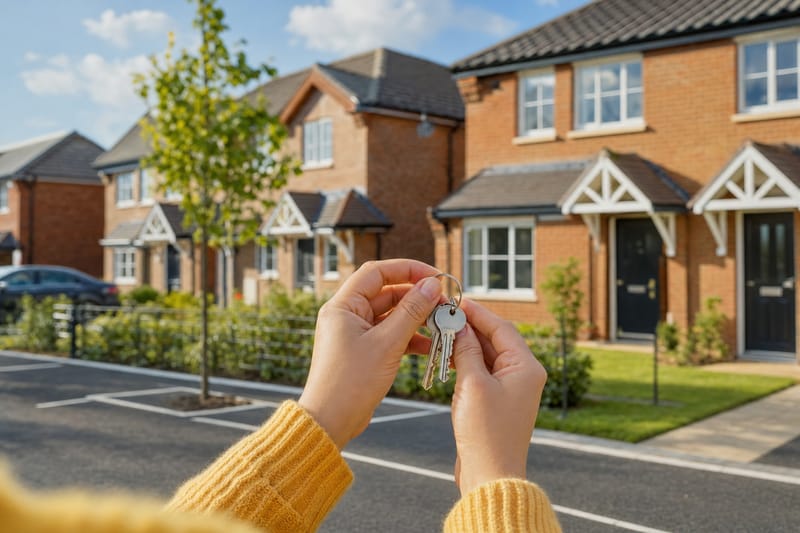
The First Homes scheme is a government initiative that lets eligible first-time buyers purchase a new build home at a permanent discount of between 30% and 50% below its full market value. Unlike a builder incentive or a cashback offer, this discount is not a one-off saving — it is written into the title deeds of the property and stays with the home forever, reducing the price for every future first-time buyer who purchases it down the line.
For someone struggling to save a deposit or borrow enough on today’s mortgage rates, a 30% reduction on a new two-bedroom home can be the difference between renting for another five years and getting the keys this year. But the scheme is not simply "cheap new build for anyone who wants one." It comes wrapped in eligibility tests, local connection requirements, income caps, and resale restrictions that catch a lot of buyers out — usually not when they buy, but years later when they try to sell.
This guide walks through exactly how the discount is calculated and locked in, who actually qualifies, how local connection rules work in practice, what happens on resale, and the questions you should ask a developer or estate agent before you reserve a First Homes plot.
If you’re also weighing up other routes onto the ladder, it’s worth reading our guides on how the Lifetime ISA works for new build home deposits and the wider first-time buyer jargon buster alongside this one, since First Homes is often confused with Shared Ownership or the now-closed Help to Buy equity loan.
How the 30–50% Discount Actually Works
Every First Homes property is sold at a discount to its full open market value (OMV). An independent RICS-qualified valuer assesses what the home would sell for on the open market with no restrictions attached, and the discount — typically 30%, though some local authorities set it at 40% or 50% — is deducted from that figure to arrive at the price you actually pay.
Crucially, the discount is not a mortgage subsidy or a loan you repay later, unlike the old Help to Buy equity loan. It is a genuine reduction in the purchase price, secured through a legal restriction registered against the title at the Land Registry (usually via a Section 106 planning agreement or a specific First Homes restriction). This means:
- You buy 100% of the property outright — there is no separate share owned by a housing association, unlike Shared Ownership.
- You get a standard mortgage on the discounted price, from a lender that supports First Homes lending.
- The discount percentage is fixed for the life of the property, not just for your ownership. When you eventually sell, the buyer after you must also qualify as an eligible first-time buyer and will pay the same discount percentage off the then-current market value.
| Example | Open market value | Discount | Price you pay |
|---|---|---|---|
| Standard 30% discount site | £280,000 | 30% | £196,000 |
| Higher-discount site (some councils set 50%) | £280,000 | 50% | £140,000 |
| London borough example | £420,000 | 30% | £294,000 |
The percentage is set locally, not nationally, because each council decides the discount level for sites in its area as part of its local plan and Section 106 negotiations with the developer. That means two nearby developments in different boroughs can offer different discount levels for what looks like a similar home.
Always ask the sales team or the council’s planning portal what specific discount percentage applies to the plot you’re looking at — it is not automatically 30% everywhere, and marketing material doesn’t always make this clear upfront.
Because the discount is fixed as a percentage rather than a cash amount, your saving in pounds grows if local house prices rise before you buy, but your resale price is capped in the same proportion when you eventually move on — you don’t get to keep 100% of any market growth, only your equity share of it.
First Homes Scheme Eligibility: Who Actually Qualifies
First Homes is targeted specifically at first-time buyers who need help getting onto the ladder but who can still realistically afford a mortgage on a discounted home. The core eligibility tests, as of 2026, are:
- First-time buyer status — you (and anyone buying with you) must never have owned a home anywhere in the world, in line with the standard first-time buyer definition used for stamp duty relief.
- Household income cap — combined gross household income must typically be no more than £80,000 a year, rising to £90,000 in Greater London. This is checked at the point of reservation, not adjusted later if your income rises.
- Mortgage requirement — you must take out a mortgage or home purchase plan for at least 50% of the discounted purchase price. This rule exists to stop cash buyers or investors gaming the discount, and it means you can’t simply buy outright with savings or family gifts alone.
- Ability to afford the discounted price — lenders will still run normal affordability checks; the discount doesn’t bypass responsible lending rules.
- Local connection or priority group membership — covered in detail in the next section, but this is often the rule that disqualifies buyers who assume the scheme is open nationally to anyone who qualifies financially.
Priority is often given, at the council’s discretion, to specific groups even ahead of general first-time buyers, including current and former members of the armed forces, and key workers such as NHS staff, teachers, and police officers, depending on how the local authority has structured the scheme for that site.
One detail that surprises a lot of applicants: being a first-time buyer for First Homes purposes is not quite identical to the stamp duty definition. If you or your partner have previously owned a share in a property anywhere in the world — including overseas, or as part of a Shared Ownership staircasing arrangement — you may be excluded even if you qualified for first-time buyer stamp duty relief on an earlier purchase attempt. Always confirm your specific circumstances with the selling agent and your solicitor rather than assuming eligibility.
Local Connection Rules: The Catch Most Buyers Miss
This is the part of the First Homes scheme that trips up the most applicants. Local councils are allowed — and in most areas required — to give first refusal on First Homes properties to buyers with a "local connection" to the area before the properties are marketed more widely, and in some boroughs, a local connection is a hard requirement rather than just a priority.
A local connection is usually defined by one or more of the following, though the exact wording varies by council:
- You currently live in the local authority area, or have done for a set period (commonly at least three of the last five years).
- You currently work in the local authority area, typically for a minimum number of hours per week.
- You have a close family member (often a parent, sibling, or child) who has lived in the area for a defined period.
- You have an existing connection recognised under the council’s allocations policy, such as a former resident returning to the area, or a member of the armed forces or veteran connected to the area.
Some councils apply local connection tests only for an initial marketing window (say, the first three months a plot is on sale), after which unsold First Homes plots open up to first-time buyers from anywhere. Others apply the local connection requirement permanently. This detail is set out in the Section 106 agreement for each specific site and is not standardised nationally, so you cannot assume a First Homes listing you see advertised is actually open to you.
Before you fall in love with a First Homes plot on a development outside your current area, check the council’s specific local connection policy for that site — it is usually published on the local authority’s housing or planning webpages, and the developer’s sales office should also confirm it in writing.
| Local connection scenario | Typically eligible? |
|---|---|
| Lived in the borough for 4 of the last 5 years | Usually yes |
| Work full-time in the borough, live elsewhere | Often yes, check specific policy |
| No live/work connection, but parents live locally | Sometimes, if policy recognises family connection |
| No connection at all, buying purely because the home is discounted | Frequently not eligible, or only after marketing window lapses |
| Serving armed forces personnel or veterans (any area) | Often exempt from local connection tests nationally |
If you're relocating for a job or want to move to an area you don't currently have ties to, factor this in early — a First Homes discount you can't actually qualify for because of geography is not a viable plan B.
Which New Builds Actually Offer First Homes
First Homes plots aren’t available on every development. The scheme is delivered through the planning system: when a council grants planning permission for a qualifying new build scheme, it typically requires a proportion of the affordable housing on that site — often at least 25% of the total affordable housing contribution — to be delivered as First Homes, secured through the Section 106 agreement.
In practice, this means:
- Smaller developments (often those below around 10–40 units, depending on the council’s local plan thresholds) may be exempt from affordable housing requirements altogether, and therefore won’t offer any First Homes plots at all.
- Larger developments will usually have a fixed number of First Homes plots, identified from the outset, rather than every unit on the site being eligible.
- The specific plots allocated as First Homes are decided early in the design process and marketed as such — you can't ask a developer to apply the discount to a market-price plot you've already picked out.
- Rural exception sites and some designated rural areas may have different rules, sometimes with permanently higher local connection requirements to protect housing for local communities.
Major national and regional housebuilders across the UK deliver First Homes plots as part of their standard planning obligations, so you'll find them mixed into developments from large volume builders as well as smaller regional developers — it depends entirely on the specific site's Section 106 agreement, not on which builder is involved.
When you're browsing developments on a portal like this one, look for First Homes callouts in the scheme details, but always verify directly with the sales office or the local authority, since allocations and availability change as plots sell and new phases release.
How to Find and Reserve a First Homes Property
Because First Homes plots are limited in number and often prioritised locally, the process of securing one is more competitive and more paperwork-heavy than buying a standard market-price new build. A typical route looks like this:
- Register interest early. Many councils and developers run a waiting list or expression-of-interest register for First Homes plots on upcoming phases, sometimes months before the plots are formally released for sale.
- Confirm eligibility upfront. The developer or a nominated housing provider will typically ask for proof of first-time buyer status, income evidence (payslips, tax returns, or an accountant's certificate if self-employed), and evidence of local connection where required, before you're allowed to reserve.
- Get an agreement in principle from a First Homes-friendly lender. Not every mortgage lender supports First Homes purchases, so this needs to happen before or alongside reservation, not after.
- Reserve the plot, usually with a reservation fee similar to a standard new build purchase, subject to the eligibility checks above being satisfied.
- Instruct a solicitor experienced with First Homes and Section 106 restrictions — this is not a standard conveyancing transaction, and the title restriction wording needs careful review.
- Independent valuation. A RICS valuer (often instructed by your mortgage lender) confirms the open market value the discount will be calculated against.
- Exchange and completion, following broadly the same stages as any new build purchase — see our exchange to completion guide for first-time buyers for what happens at this stage.
Some developers manage First Homes eligibility checks in-house; others use a nominated local housing association or the council's own housing team to verify applicants before releasing plots for sale. Ask early who is actually running the eligibility process for the specific site you're interested in, since delays here are a common reason First Homes purchases take longer than standard new build sales.
Don't put down a reservation fee on a First Homes plot before your eligibility has been formally confirmed in writing — verbal assurances from a sales negotiator are not the same as sign-off from the council or nominated housing provider.
Resale Restrictions: What Happens When You Sell
This is the section that catches out buyers who treat First Homes purely as "a cheap new build" without thinking through the exit. The discount is permanent, and it is inherited by every future owner — which means when you come to sell, you cannot simply list the property at full market value and pocket the difference.
The core resale rules are:
- The same discount percentage applies on every future sale. If you bought at a 30% discount, you must sell at a 30% discount to the property's market value at the time of that future sale — assessed again by an independent valuer.
- Your buyer must also be an eligible first-time buyer under the First Homes rules current at the time of resale, including local connection tests if the council still applies them, income caps (which may have been updated by then), and the 50% mortgage requirement.
- You cannot rent the property out on a long-term basis in most cases — First Homes are intended as owner-occupied housing, and the restriction typically prohibits letting the whole property, though this varies by the specific Section 106 wording.
- Local authorities retain oversight of resales, often via a "nomination" or notification process where you must inform the council or a monitoring officer before marketing the home, so they can check the incoming buyer qualifies.
- You keep your equity gain in proportion — if the home's open market value has risen since you bought, your 70% share (after a 30% discount) rises in cash terms too, but you never get the full 100% appreciation.
| Scenario at resale | What happens |
|---|---|
| Market value has risen since purchase | You benefit from your proportional share of the increase; the discount percentage still applies to the new higher value |
| Market value has fallen | Your resale price falls in proportion too — the discount doesn't protect you from a falling market |
| You want to sell to a family member who isn't a first-time buyer | Not permitted unless they independently meet First Homes eligibility |
| No eligible buyer comes forward within a marketing period | Council or housing provider may have powers to nominate a buyer, or in limited cases some flexibility is agreed — check the specific Section 106 terms |
Because of these restrictions, First Homes properties typically have a smaller pool of potential buyers than an unrestricted home in the same street, which can mean a longer marketing period when you eventually sell. This is a genuine trade-off for the discount you received, not a hidden defect — but it should factor into your decision if you expect to move again within a few years.
Mortgages for First Homes: What Lenders Require
Not every mortgage lender offers products for First Homes purchases, because the title restriction and resale rules mean the lender's security is slightly different from a standard freehold or leasehold new build. Several major high street lenders and some specialist and building society lenders do support the scheme, but product availability and criteria change, so a mortgage broker familiar with First Homes is genuinely useful here rather than optional.
Key things to know about First Homes mortgages:
- The loan is based on the discounted purchase price, not the open market value — so your borrowing needs, and therefore affordability assessment, are calculated against the lower figure.
- You must borrow at least 50% of the discounted price as a mortgage, as set by the scheme rules, meaning you can't buy with a very small mortgage plus large cash deposit or family gift covering most of the cost.
- Standard affordability and stress-testing rules still apply — lenders will check income, existing debt, credit history, and outgoings in the normal way against current Financial Conduct Authority responsible lending requirements.
- Valuers instructed by the lender need to understand First Homes — ask your broker to confirm the panel valuer has experience with the scheme, since an unfamiliar valuer can cause delays or an incorrect open market value assessment.
- Deposit requirements are otherwise standard — you'll typically still need a deposit of at least 5–10% of the discounted price, and the same range of fixed and tracker rate products are generally available, subject to the lender's specific First Homes criteria.
If you're using a Lifetime ISA to help build your deposit for a First Homes purchase, check the property price cap rules carefully — LISA withdrawal rules are based on the actual purchase price you're paying (the discounted figure), which can work in your favour if a First Homes property would otherwise have exceeded the LISA's regional price cap at full market value. See our guide on how the Lifetime ISA works for new build home deposits for the detail on price caps and withdrawal penalties.
Get a mortgage broker involved before you reserve, not after — not all First Homes-supporting lenders serve every part of the country, and a poorly matched Agreement in Principle can cost you weeks during a competitive plot release.
First Homes vs Shared Ownership vs a Standard New Build Purchase
First Homes is often mentioned in the same breath as Shared Ownership and the closed Help to Buy equity loan, but the mechanics are genuinely different, and choosing the wrong scheme for your circumstances can cost you money or simply mean you don't qualify at all.
| Feature | First Homes | Shared Ownership | Standard new build purchase |
|---|---|---|---|
| Ownership share | 100%, outright | Typically 25–75% initially, rest rented from housing association | 100%, outright |
| Discount type | Permanent 30–50% off market value, fixed on title | No discount as such — you only pay for your owned share plus rent on the rest | None, unless a time-limited developer incentive applies |
| Ongoing costs beyond mortgage | Standard service charge/ground rent if leasehold | Rent on unowned share plus service charge/ground rent | Standard service charge/ground rent if leasehold |
| Local connection rules | Often required, council-dependent | Sometimes required, less commonly enforced | None |
| Resale restriction | Permanent discount and eligibility rules for future buyers | Staircasing rules; may need housing association nomination period | None |
| Income cap | £80,000 (£90,000 in London), typically | Similar caps often apply, check locally | None |
| Best suited to | Buyers who want full ownership and are comfortable with resale restrictions | Buyers who can't afford full ownership even at a discount, want lower entry cost | Buyers with no scheme eligibility, or who prefer no restrictions |
Help to Buy (equity loan) closed to new applications in England in 2023, so it's no longer a live comparison for new reservations, though you may still encounter existing Help to Buy owners selling on — that's a different transaction with its own repayment rules, covered in our guide on what Help to Buy equity loan repayment actually costs.
Deposit Unlock and other new build mortgage indemnity schemes are a further alternative worth knowing about: rather than a discount, these let you buy at full price with a smaller deposit (often 5%) via a mortgage guarantee arrangement with participating lenders and builders, without any of the local connection or resale restriction complexity of First Homes. Which route suits you depends on whether your main obstacle is deposit size, monthly affordability, or simply local house prices being out of reach even at a market-rate mortgage.
Pros and Cons of Buying a First Homes New Build
Weighing up whether to pursue a First Homes plot means being honest about the trade-offs, not just the headline discount.
Advantages
- A genuine, permanent reduction in purchase price — not a temporary offer or a repayable loan.
- You own 100% of the property from day one, unlike Shared Ownership, so you don't pay rent on a portion you don't own.
- Lower purchase price generally means a smaller deposit in cash terms and lower monthly mortgage payments than buying the same home at full market value.
- Stamp duty is calculated on the discounted price, not the open market value, which can be a meaningful additional saving depending on the price band you fall into.
- Priority local connection rules can work in your favour if you already live or work in the area, reducing competition from buyers elsewhere.
Disadvantages and risks
- Local connection rules can exclude you entirely if you're relocating to a new area, even if you meet every financial criterion.
- A smaller future buyer pool at resale can mean a longer time on the market and more negotiating pressure on price when you come to sell.
- The 50% minimum mortgage requirement limits flexibility for buyers who'd prefer to put down a larger cash deposit and borrow less.
- Not every lender supports First Homes, which can narrow your choice of mortgage products and rates compared with a standard purchase.
- Renting the property out is generally restricted, so it doesn't suit buyers who might need to relocate for work and let the home out rather than sell.
- Eligibility criteria (income caps, local connection policy) can change over time, which matters if you plan ahead for family members or friends who might buy from you later.
The discount is real and the ownership is genuine, but First Homes is best understood as a scheme with a different risk profile to a standard purchase — not simply "the same house, cheaper."
Questions to Ask Before You Reserve a First Homes Plot
Before you put down a reservation fee, get clear written answers to these questions from the developer's sales team, the council, or your solicitor — verbal reassurance is not sufficient given how much rests on the exact wording of the Section 106 agreement for that specific site.
- What exact discount percentage applies to this plot — 30%, 40%, or 50% — and is it confirmed in the Section 106 agreement or still provisional?
- Does a local connection requirement apply, and if so, exactly how is it defined and for how long does it apply (initial marketing period only, or permanently)?
- Who verifies eligibility — the developer directly, a nominated housing association, or the council's housing team — and what is the expected timeframe for sign-off?
- Which lenders on the market currently support First Homes purchases in this area, and has your broker confirmed an Agreement in Principle against the discounted price?
- What restrictions apply to letting the property, in case your circumstances change and you need to move away temporarily?
- Is there a nomination or notification process required before you can market the property for resale, and how long does that typically take based on recent sales at this development or similar sites nearby?
- Has the council updated its income cap or local connection policy recently, and is there any indication it may change again soon?
- What service charge and ground rent (if leasehold) apply, since these are calculated on the actual property, not the discounted price, and can be easy to overlook when budgeting around a reduced purchase price.
It's also worth checking how the specific developer has handled First Homes elsewhere. Builder quality and aftercare standards apply equally to First Homes plots as to full-price homes on the same development, so the same due diligence applies — our guide on using the HBF star rating to compare new build developers is a useful starting point, alongside checking whether the development is covered by NHBC, LABC, or Premier Guarantee warranty cover and registered with the New Homes Quality Board.
| Check | Why it matters |
|---|---|
| Section 106 agreement wording for the site | Confirms discount %, local connection rules, and resale process precisely |
| Lender panel and valuer experience with First Homes | Avoids delays and mispriced valuations during the mortgage process |
| Council housing team contact and current policy document | Confirms whether local connection or income cap policy has changed recently |
| Solicitor's experience with First Homes title restrictions | Reduces risk of missing an unusual clause specific to that site |
A Realistic Timeline: From Registering Interest to Moving In
First Homes purchases generally take longer than a standard new build sale, largely because of the extra eligibility verification steps. Here's a realistic worked timeline, though exact durations vary by council, developer, and how quickly you can provide documentation.
| Stage | Typical duration | What happens |
|---|---|---|
| Registering interest | Weeks to months before plot release | Join the developer or council's First Homes interest list for the development |
| Eligibility verification | 2–6 weeks | Income evidence, first-time buyer proof, and local connection documentation reviewed by the developer, housing association, or council |
| Mortgage Agreement in Principle | Days to 2 weeks | Broker sources a First Homes-compatible lender based on the discounted price |
| Reservation | 1 day | Reservation fee paid, plot taken off the market subject to eligibility sign-off |
| Independent valuation | 1–2 weeks | RICS valuer confirms open market value to calculate the discounted price |
| Mortgage application and offer | 3–6 weeks | Full underwriting against the discounted price and your financial circumstances |
| Legal work and exchange | 4–10 weeks | Solicitor reviews the Section 106 restriction and title; exchange of contracts follows |
| Completion | On or shortly after build completion for off-plan purchases | Keys handed over; move-in day |
Buying off-plan adds its own timeline considerations on top of this — construction delays can shift your completion date regardless of how smoothly the First Homes eligibility process goes. If you're reserving early in a development's build programme, budget for the possibility that build completion, not eligibility paperwork, becomes the longest pole in the tent. Our first-time buyer timeline guide covers the general off-plan buying process in more depth if this is your first new build purchase.
One practical tip: keep your income evidence and identity documents up to date and easily accessible throughout the process, since you may be asked to re-confirm eligibility if there's a significant gap between your initial verification and legal completion, particularly on longer off-plan builds.
Frequently Asked Questions
Is the First Homes discount the same everywhere in the UK?
No. The percentage (typically 30%, though some councils set 40% or 50%) is decided locally by each council and written into the Section 106 agreement for the specific development, so it varies by site and by area. Always confirm the exact figure for the plot you're considering rather than assuming it's a flat national 30%.
Can I buy a First Homes property if I don't have a local connection to the area?
It depends on the council's policy for that specific site. Many apply a local connection requirement, at least during an initial marketing period, though this doesn't apply everywhere and armed forces personnel and veterans are often exempt from local connection tests nationally. Check the specific policy before assuming you qualify.
Do I have to sell my First Homes property back to the council?
No, you sell it on the open market in the normal way, but the sale price must reflect the same discount percentage off the current market value, and your buyer must independently meet First Homes eligibility criteria at the time of that sale, including any local connection and income tests then in force.
Can I rent out a First Homes property if I need to move away?
Generally no. First Homes restrictions typically prohibit letting the whole property on a long-term basis, since the scheme is intended for owner-occupation. The exact wording varies by Section 106 agreement, so check with your solicitor if this is a realistic possibility for your circumstances.
What happens if I can no longer afford the mortgage on a First Homes property?
The same processes apply as with any residential mortgage in arrears — you should contact your lender early, and options may include payment holidays, term extensions, or, in a worst case, a repossession and sale process. The resale restrictions still apply even in a forced sale scenario, which can affect how quickly the property sells.
Is First Homes the same as Shared Ownership?
No. With First Homes you own 100% of the property outright at a discounted price. With Shared Ownership you buy a smaller share (commonly 25–75%) and pay rent to a housing association on the remainder, with the option to buy further shares over time through staircasing.
Does the First Homes discount reduce my stamp duty?
Yes, in most cases stamp duty (or the equivalent land transaction tax in Scotland and Wales) is calculated on the discounted purchase price you actually pay, not the full open market value, which can bring your transaction into a lower tax band or below the first-time buyer threshold entirely, depending on current rates.
Can I use a Lifetime ISA towards a First Homes purchase?
Yes, provided the property and purchase otherwise meet Lifetime ISA rules. Because LISA price caps are assessed against the actual price you're paying, the discounted First Homes price can sometimes bring an otherwise-too-expensive property within the LISA's regional cap — check current thresholds carefully before relying on this.
Next Steps
If a First Homes discount looks like the right route onto the ladder for you, start by narrowing down where you actually have a realistic chance of qualifying, then work through eligibility, mortgage, and legal checks in parallel rather than leaving any of them until the last minute.
- Search live developments to see which schemes near you are advertising First Homes plots, and note which phases are currently releasing.
- Use the map to check developments against areas where you already have a genuine local connection through living or working there.
- Browse properties for sale to compare First Homes-eligible plots against similarly sized homes at full market value in the same area.
- Look up builders active in your target area and check their track record and warranty provider before committing to a specific site.
- Use our compare tool to weigh up a First Homes plot against Shared Ownership or standard purchase options side by side on cost and monthly outgoings.
- Explore the wider tools section for mortgage affordability calculators and stamp duty estimators to model the discounted price scenario before you commit to a reservation fee.
Whatever route you take, get a mortgage broker and a solicitor with genuine First Homes experience involved early — the scheme's rules are workable and the discount is real, but the details of eligibility, local connection policy, and resale restriction wording differ enough from site to site that generic new build buying advice won't cover every gap.