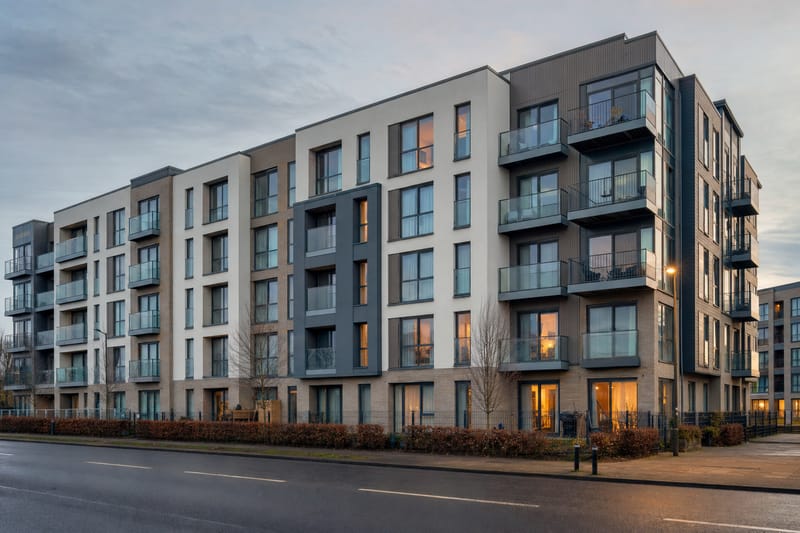
If you're buying a new build flat in England or Wales, you might assume that cladding scandals and EWS1 forms are a problem for older, pre-Grenfell blocks — not for an apartment with a 2026 completion certificate. That assumption is not always safe. Buildings completed well after the Grenfell Tower fire in 2017 have still been asked for EWS1 assessments, and some have needed remediation work, because the external wall system used at the time didn't meet the standards now expected, or because a mortgage lender's valuer simply won't lend without paperwork confirming the building is safe.
This guide sets out, in plain terms, when an EWS1 form is likely to be needed on a new build apartment, what it costs to obtain, how the Building Safety Act 2022's leaseholder protections work in practice, and — critically — what costs those protections don't cover. If you're weighing up a new build flat purchase, particularly in a building over 11 metres or five storeys, this is the due diligence that sits alongside your solicitor's searches and your mortgage offer.
The core issue for new build buyers is this: the Building Safety Act 2022 introduced real protections for "qualifying leaseholders", capping some remediation costs and shifting responsibility back toward developers and freeholders. But those protections have edges. Non-qualifying leaseholders, buy-to-let owners with multiple properties, and costs outside the defined "relevant defects" can still land on individual flat owners. Understanding where those edges are before you exchange contracts is far more useful than discovering them after you've bought.
We'll also cover how this affects your ability to get a mortgage, what to ask the developer's sales team and your conveyancing solicitor, and how to check a specific building's remediation status before you commit.
When Is an EWS1 Form Actually Required?
There's no single law that says "this building needs an EWS1 form". Instead, the requirement is driven by lender risk appetite, following guidance originally issued by RICS, UK Finance and the government. In practice, the trigger points that new build buyers should know are:
- Buildings over 18 metres (roughly six storeys): Almost always in scope. These are also "higher-risk buildings" under the Building Safety Act, with additional registration and safety case duties.
- Buildings between 11 and 18 metres: Increasingly likely to be asked for an EWS1, especially if there is any balcony decking, cladding, or render system that a valuer's surveyor can't visually confirm is non-combustible from a standard inspection.
- Buildings under 11 metres: Government guidance (and the 2021 "consolidated advice note" that superseded it) states EWS1 forms should not normally be needed on low-rise blocks. Some lenders still ask in edge cases, particularly if there are multiple blocks on one estate sharing a shared external wall design.
New build flats get caught out for reasons that surprise buyers:
- Design changes mid-construction. A development approved with one external wall specification may be built with a substituted product due to supply issues, requiring re-assessment.
- Balcony construction. Timber decking or certain composite balcony materials on stacked balconies have triggered EWS1 requests even on newer buildings.
- Mixed-use podium blocks. Flats sitting above retail or car parking on a podium can be measured differently for height purposes, pushing a building that "looks" low-rise into higher-risk categorisation.
- Insulation and cavity barrier defects. Post-completion snagging or NHBC inspections occasionally uncover missing fire-stopping or cavity barriers, which can trigger a wider external wall review even without cladding in the traditional sense.
A building being "new build" tells you nothing about its EWS1 status on its own. What matters is height, external wall construction, and whether a lender's specific panel of valuers asks for the form on that development.
If you're comparing developments, it's worth checking listings and floorplans via /developments for building height and construction type before you get attached to a particular block, and asking the developer directly whether an EWS1 has already been obtained for the building as a whole.
What an EWS1 Assessment Actually Costs
The EWS1 form itself is free to complete — it's a one-page RICS document. The cost sits in the fire engineering and surveying work needed to reach a professional judgement about the external wall system, which for a whole building (not an individual flat) typically involves:
- A qualified fire engineer or chartered surveyor with relevant competence carrying out an intrusive or semi-intrusive inspection.
- Opening up sections of the external wall (sometimes several locations per elevation) to check insulation type, cavity barriers and fixings.
- Reviewing original design drawings, warranty documents and as-built records against what's actually on the building.
- Producing a fire risk appraisal of external walls (FRAEW) report, from which the EWS1 form is then issued.
Crucially, this is a cost that falls on the building as a whole, not on you individually as a flat buyer — it's usually commissioned by the freeholder or management company and, historically, recharged through the service charge unless covered by a developer or government remediation fund. This is exactly the kind of cost the Building Safety Act's leaseholder protections were designed to address, which we cover next.
Timing matters too. A FRAEW-backed EWS1 assessment on an occupied building can take anywhere from a few weeks to over a year to commission, schedule and complete, particularly where scaffolding access is needed. If you're buying off-plan or shortly after completion and the building hasn't yet needed one, that's not a guarantee it never will — but it does mean there's no existing report to review.
| Building type | Typical EWS1/FRAEW cost (2026, indicative) | Typical timescale |
|---|---|---|
| Low-rise, single block, simple render/brick | £3,000–£8,000 | 4–10 weeks |
| Mid-rise (11–18m), rendered/cladded panels | £8,000–£20,000 | 2–6 months |
| High-rise tower (18m+), complex facade | £20,000–£60,000+ | 4–12 months |
These figures are indicative and will vary by region, access constraints and the fire engineer's findings — always ask the managing agent for the actual quote or invoice for your specific building rather than relying on general figures.
The Building Safety Act 2022: What It Changed for Leaseholders
The Building Safety Act 2022 (BSA) is the main piece of legislation that reshaped who pays for cladding and other fire safety defects. Before it, leaseholders in affected buildings routinely faced five- or six-figure service charge demands to fix problems they had no part in creating. The Act tried to shift that burden toward the parties who caused or profited from the defect — developers, contractors and, in some cases, freeholders — while protecting a defined category of "qualifying leaseholders" from the worst of the costs.
Key mechanisms introduced by the Act include:
- The leaseholder protections (Schedule 8): Rules that cap or eliminate certain remediation costs for qualifying leaseholders in relevant buildings.
- Remediation orders and Remediation Contribution Orders: Powers for the First-tier Tribunal to force landlords, developers or associated companies to pay for remediation or to contribute to costs already incurred.
- The Responsible Actors Scheme and developer pledges: A government-run scheme requiring larger developers to sign up to fix life-critical fire safety defects in buildings they developed or refurbished, with consequences (including being barred from building control approvals) for those who don't.
- The Building Safety Regulator: A new regulator (part of the Health and Safety Executive) overseeing higher-risk buildings (generally 18m+ or 7+ storeys) through design, construction and occupation.
The Act's central idea is "polluter pays": developers and those who created defects should fund remediation, not leaseholders who bought in good faith. In practice, whether that principle protects you depends heavily on your specific lease, building height, and ownership history.
For new build flat owners, the encouraging part is that if your developer is a signatory to the Responsible Actors Scheme (most major national housebuilders are, including the largest volume builders), they have committed to fixing life-critical defects in buildings they built without passing the cost to leaseholders, regardless of the leaseholder protection technicalities. The less encouraging part is that this commitment covers specific historic defects and doesn't necessarily extend to every future issue, smaller or regional developers who haven't signed up, or costs that fall outside the defined scope of "relevant defects".
The Leaseholder Cost Cap: Who Qualifies and How It Works
The most important protection for most flat owners is the leaseholder cost cap under the Building Safety Act. To benefit, you must be a "qualifying leaseholder", which generally means:
- Your lease was granted before 14 February 2022 (the date the relevant provisions were introduced), or you bought after that date but the qualifying status was already attached to the flat and correctly passed on.
- The flat was your only or principal home at the qualifying date, or you own no more than three UK residential properties in total (including the one in question).
- The building is at least 11 metres or five storeys, in England (Wales has a similar but separately implemented regime).
Where you do qualify, the Act sets contribution caps depending on your property's value band and location (London and outside London bands differ), covering a defined list of "relevant defects" — broadly, defects relating to fire safety or structural safety that arose from work carried out in the 30 years before the Act, including cladding, insulation and some associated remediation costs like waking watch (temporary fire patrols) in the interim.
| Qualifying leaseholder situation | Cost cap treatment (indicative, check current figures) |
|---|---|
| Only/main home, property value under roughly £175,000 (outside London) | £0 — no contribution to relevant defect remediation |
| Only/main home, mid-value property band | Capped contribution, typically a five-figure sum spread over up to 10 years |
| Owns a second UK property (up to 3 total) | Still qualifying, but caps and contribution history may differ |
| Owns 4+ UK residential properties | Non-qualifying — cap does not apply; full costs can be sought |
Two things trip buyers up repeatedly. First, qualifying status and any contributions already made under the cap are meant to transfer with the property when it's sold — your solicitor should confirm this via a leaseholder deed of certificate during conveyancing. Second, "relevant defects" is a defined legal term; if your building's problem falls outside it (for example, some unrelated structural issues, or defects arising from work done more than 30 years before the Act commenced), the cap may not apply at all.
What the Cap Doesn't Cover: Costs You Could Still Face
The leaseholder protections are genuinely valuable, but they were never designed to make remediation free for everyone. New build flat owners should go into a purchase understanding the gaps:
- Non-qualifying leaseholders. As covered above, owning more than three properties, or the flat not being your only/main home at the relevant qualifying date, can remove the cap entirely.
- Interim safety measures before remediation completes. Waking watch costs (staff patrolling for fire risk pending remediation) are partially addressed by the Act but historically caused severe short-term service charge spikes; some interim costs can still reach leaseholders depending on timing and building status.
- Buildings under 11 metres. The core Schedule 8 protections are generally aimed at buildings of 11m+ / five storeys+. Lower-rise blocks with genuine defects sit in a greyer area, and remediation cost recovery there relies more heavily on general leasehold law, warranty claims and, where available, developer goodwill.
- Non-"relevant" defects. General disrepair, ordinary wear, or safety issues unrelated to the statutory definition of relevant defects aren't covered by the cap — only fire and structural safety defects connected to relevant works are.
- Increased buildings insurance premiums. Even where remediation costs themselves are capped or covered, buildings insurance premiums for blocks with known cladding issues have often risen sharply, and insurance costs sit outside the leaseholder protection cap — they get passed through the service charge as normal.
- Legal and administration costs of disputes. If your qualifying status or the defect classification is contested and needs a First-tier Tribunal application, legal costs and time are a real (if less visible) burden.
The cap limits what you can be charged for defined remediation of relevant defects — it doesn't guarantee your service charge won't rise, and it doesn't cover every fire-safety-adjacent cost a building might incur.
For buy-to-let buyers specifically, it's worth reading how EPC and regulatory change is separately reshaping flat ownership costs — see How Upcoming EPC Rules Affect New Build Buy-to-Let Investors — since cladding risk and energy efficiency obligations increasingly sit alongside each other in block management budgets.
Developer Responsibility: The Pledge, the Scheme, and Its Limits
A large part of why new build flat owners are less exposed than owners of 2000s-era ex-council conversions or older private blocks is developer responsibility. Since 2022, most major UK housebuilders have signed developer remediation contracts committing them to:
- Fund or carry out remediation of life-critical fire safety defects in buildings over 11 metres that they developed or refurbished in the relevant period.
- Reimburse leaseholders and freeholders for reasonable costs already paid toward remediation of such defects.
- Not pass these costs on to leaseholders through the service charge.
The government's Responsible Actors Scheme sits alongside this, with the ability to restrict non-compliant developers from receiving building control sign-off on new developments — a significant commercial lever that has pushed most large builders to sign up.
Where this gets more complicated for new build buyers:
- Smaller and regional developers may not be signatories at all, particularly on smaller schemes, joint ventures, or where the original developer has since been dissolved, sold, or gone into insolvency.
- Freehold structure matters. If the freehold has been sold on to a third-party investment fund since completion (common with new build estates), the current freeholder may not be the party bound by the developer's pledge, even though they're the one billing you.
- Timing gaps remain. A developer's commitment to remediate doesn't remove the interim reality of needing an EWS1 for a mortgage valuation, or the wait between a defect being identified and works actually starting.
Practical takeaway: ask the developer's sales team directly whether they are a signatory to the developer remediation contract, and ask your solicitor to confirm the current freeholder and whether any remediation commitments transfer with the building's ownership.
Why Genuinely New Builds Still Get Caught Up in This
It's tempting to think a flat completed in 2024, 2025 or 2026 simply can't have a Grenfell-era cladding problem, because building regulations have tightened significantly since 2018 — combustible cladding materials are now banned on relevant residential buildings over 11 metres under updated regulations. That's broadly true for the cladding material itself. But new build flats can still end up needing an EWS1 or facing remediation costs for reasons distinct from "the wrong cladding was specified":
- Snagging and quality control failures. Fire-stopping, cavity barriers and compartmentation are notoriously easy to install incorrectly and hard to inspect after the fact. NHBC and other warranty providers have identified fire-stopping defects in new developments during routine and complaint-driven inspections.
- Balcony and decking materials. Some newer buildings used timber or composite decking on stacked balconies that has since been reassessed as a fire risk pathway, triggering remediation even where wall cladding itself is compliant.
- Design-and-build contractor substitutions. Products specified at design stage sometimes get substituted during construction for cost or supply reasons; if the substitute wasn't properly re-certified against fire performance, it can create a genuine defect in an otherwise modern building.
- Lender caution outlasting the actual risk. Even where a building is compliant, some lenders' panel valuers request an EWS1 as a blanket policy for any building over a certain height with visible render, rainscreen panels or ACM-adjacent materials, simply to avoid liability — adding cost and delay even when no defect is later found.
A 2026 completion date reduces your risk, but it doesn't eliminate it. The safest assumption for any flat above roughly four or five storeys is: check the specific building's assessment history, don't rely on the build date alone.
This is one reason it's worth reviewing how new build snagging processes work more broadly before you rely on "it's brand new" as reassurance — see New Build Plaster Cracks: Snagging Issue or Normal Settlement? for how defect identification typically plays out in the first two years of ownership.
How This Affects Getting a Mortgage on a New Build Flat
Cladding and EWS1 concerns aren't purely a leasehold cost issue — they're also a lending issue, and this often surfaces earlier in your purchase journey than any service charge demand. Lenders' valuers are instructed to flag external wall risk on any relevant building, and if an EWS1 is requested but not available, several things can happen:
- The lender may down-value the flat, reducing how much they'll lend against it.
- The lender may refuse to lend at all until an EWS1 (rated A1, A2 or A3 depending on findings) is produced.
- Even with an EWS1, a B2 rating (meaning combustible materials are present and remediation is needed) will typically stop mainstream lending until works are complete or a suitable indemnity/cap arrangement is documented.
| EWS1 rating | What it means | Typical lending outcome |
|---|---|---|
| A1 | No cladding materials present, no remediation needed | Normal lending |
| A2 | Cladding present but fire risk considered low; no remediation needed | Normal lending in most cases |
| A3 | Cladding present, some risk, but not requiring immediate remedial works (may need monitoring) | Generally lendable, some lenders more cautious |
| B1 | Cladding present, external fire risk identified, remedial work recommended but not urgent | Case-by-case; some lenders pause |
| B2 | Combustible materials present, remediation required | Most mainstream lenders decline until works completed or cost cap protections are formally confirmed |
For off-plan and newly completed new builds, this is generally less of an issue because the building typically doesn't yet have a poor EWS1 rating on record — but it becomes relevant the moment you come to remortgage or sell, if by then the building's status has changed or a lender's panel starts requesting the form. If you're relying on a mortgage rather than cash, it's worth reading how bridging finance is sometimes used to work around exactly these kinds of valuation delays — see Bridging Loans for New Build Purchases: When They Make Sense.
The Leaseholder Deed of Certificate: What It Is and Why It Matters
If you're buying a flat in a relevant building (generally 11m+), your solicitor should raise a leaseholder deed of certificate as part of conveyancing. This is the formal document under the Building Safety Act that establishes whether you (or the seller, if you're buying a resale property, or the developer, if you're the first owner) qualify for the leaseholder protections and cost cap.
The deed of certificate records:
- Whether the flat was the leaseholder's only or principal home at the relevant date.
- How many other UK residential properties the leaseholder owns.
- Any contributions already made toward remediation costs, which count toward the overall cap when it transfers to a new owner.
For a brand-new flat bought directly from a developer, this is usually straightforward — there's no remediation history yet, and you'll typically complete a certificate confirming your own qualifying status at the point of purchase. It becomes more important, and more commonly overlooked, when buying a resale new build flat (say, a five-year-old apartment in a development that's since had cladding issues identified). In that scenario:
- Ask your solicitor to specifically request the seller's deed of certificate and landlord's certificate as part of pre-contract enquiries.
- Confirm whether any remediation costs have already been charged to the flat, and whether they count toward the cap (protecting you from double-paying).
- If the building is undergoing remediation, ask for the FRAEW report, any remediation programme timeline, and correspondence from the freeholder or managing agent about funding source (developer pledge, government fund, or leaseholder contribution).
Skipping the deed of certificate enquiry is one of the most common conveyancing gaps on flat resales in affected buildings. It's not automatic — your solicitor needs to actively request it.
If your solicitor isn't already flagging this for a flat purchase in a building over four or five storeys, ask them directly. It's a natural extension of the standard searches covered in New Build Solicitor Fees: What to Expect and How to Budget, and worth budgeting a small amount of extra solicitor time for on affected buildings.
Questions to Ask Before Buying a New Build Flat in a Taller Building
Whether you're buying off-plan, reserving a plot in a part-built development, or considering a completed apartment, these questions should form part of your due diligence alongside the usual survey and search checks:
- What is the building's height and storey count, measured for building safety purposes? Podium levels and basement car parking can change this calculation from what looks obvious on a floorplan.
- What is the external wall construction — brick, render, rainscreen cladding, or a mix? Ask for the specification, not just a marketing description like "contemporary facade panels".
- Is the developer a signatory to the government's developer remediation contract / Responsible Actors Scheme? This is a matter of public record and the developer's sales team should be able to confirm it.
- Has an EWS1 or FRAEW assessment already been carried out on this specific building, and what was the outcome? Not every building in a large phased development shares the same rating — ask about your specific block, not the estate generally.
- Who is the current freeholder, and is it linked to the original developer or a separate investment vehicle? This affects who is realistically on the hook for future remediation costs.
- What is included in the service charge budget for building safety compliance (e.g. Building Safety Act charges, fire risk assessments, waking watch contingency)? Ask to see the reserve fund and budget breakdown, not just the headline annual figure.
- If you plan to let the property, how many other properties do you (or will you) own? This affects your own qualifying leaseholder status under the cost cap, which matters if problems emerge later.
| Buyer situation | Extra check to prioritise |
|---|---|
| Buying off-plan, tower over 18m | Confirm intended external wall spec and developer's remediation contract status before exchange |
| Buying a completed flat, 5–10 storeys | Request existing EWS1/FRAEW report and freeholder identity from the seller/agent |
| Buying as a portfolio landlord (4+ properties) | Understand you may be a non-qualifying leaseholder if defects emerge; budget accordingly |
| Buying with a mortgage on a 11m+ building | Check with your specific lender whether they require an EWS1 or accept a deed of certificate instead |
None of these questions should be difficult for a reputable developer to answer. Hesitation, vague responses, or an unwillingness to confirm the freeholder's identity are themselves useful data points about a development you're considering.
How to Check a Building's Cladding and Remediation Status
Beyond asking the developer and your solicitor directly, there are practical ways to research a specific building before you commit:
- Ask the managing agent for the building's fire risk assessment and any FRAEW/EWS1 documentation on file. This is a reasonable pre-purchase enquiry and a competent agent should be able to provide it, or explain why none exists yet.
- Check the government's Remediation Acceleration Plan updates and Building Safety Regulator registers for higher-risk buildings (18m+), where registration status and remediation progress are published for buildings that fall into that category.
- Search for the development name alongside terms like "cladding", "EWS1" or "remediation" in general news search — residents' associations and local press often report on remediation issues affecting specific developments well before they show up in formal paperwork.
- Ask current residents or a residents' association, if one exists, about service charge trends and any building safety correspondence they've received. Existing owners are often more candid than sales teams about ongoing issues.
- Request the NHBC, LABC or Premier Guarantee warranty documentation and check whether any structural or fire safety claims have been logged against the building.
If you're comparing several developments or builders before deciding, it's also worth factoring build quality track record into your decision more broadly — see How to Use the HBF Star Rating to Compare New Build Developers for a way to benchmark developers on customer satisfaction and defect resolution, which correlates loosely with how seriously a builder tends to take post-completion safety issues.
Frequently Asked Questions
Can a new build flat completed in 2025 or 2026 really need an EWS1 form?
Yes, though it's less common than in older stock. Post-2018 building regulations ban combustible cladding materials on relevant taller residential buildings, which significantly reduces the risk, but EWS1 requests can still arise from balcony materials, fire-stopping and cavity barrier defects found during snagging, contractor substitutions during construction, or simply cautious lender policy on taller buildings. Height and external wall construction matter more than build date alone.
Who pays for an EWS1 assessment on a new build block?
Typically the freeholder or management company commissions and initially pays for it, with the cost usually recharged through the service charge reserve fund unless the developer agrees to cover it directly, or a relevant defect is later confirmed and covered by the developer remediation contract or government scheme.
Am I automatically a "qualifying leaseholder" under the Building Safety Act?
Not automatically. You generally need the flat to be your only or principal home (or you must own no more than three UK residential properties in total), and the building needs to meet the height and defect criteria set out in the Act. Your solicitor should confirm your status via a deed of certificate during conveyancing.
Does the leaseholder cost cap mean I'll never pay anything toward cladding remediation?
Not necessarily. It limits your contribution to a defined amount for "relevant defects" in qualifying circumstances, but it doesn't cover every possible cost — buildings insurance increases, interim safety measures, non-qualifying status, or defects that fall outside the statutory definition can still result in costs to you.
Will cladding issues affect my ability to sell the flat later?
Potentially, yes, particularly to a buyer relying on a mortgage. If a building later needs an EWS1 and doesn't have one, or has a poor rating, buyers may struggle to get lending, which can slow a sale or affect the achievable price until remediation is resolved or protections are formally documented.
Is Wales covered by the same rules as England?
Wales has its own building safety framework with broadly similar aims following the Building Safety Act and the Welsh Government's own remediation programme, but the detail of leaseholder protections and qualifying criteria differs from England's. Always check the current Welsh-specific guidance if buying there rather than assuming the English rules apply directly.
What should I do if I'm already a leaseholder and my building is being assessed?
Ask the managing agent for the FRAEW report and remediation timeline in writing, confirm your qualifying leaseholder status and request a deed of certificate if you don't already have one, and consider contacting a solicitor experienced in building safety disputes if costs are being demanded that you believe exceed the statutory cap.
Do estate agents have to disclose cladding issues when marketing a flat?
Material information that would affect a reasonable buyer's decision, including known building safety issues, should be disclosed under consumer protection rules and estate agency guidance, but disclosure standards vary in practice. Don't rely on this alone — make specific written enquiries through your solicitor rather than assuming silence means there's no issue.
Next Steps
Cladding and EWS1 risk shouldn't necessarily rule out buying a new build flat — taller apartment buildings remain a normal and often practical choice for many buyers, and the Building Safety Act has genuinely improved leaseholder protection compared to the pre-2022 landscape. But it's a due diligence item that deserves the same attention as your mortgage offer and your snagging inspection, not an afterthought discovered after exchange.
- Browse specific developments and check building height and construction details via /developments before you commit to viewing.
- Research individual builders' track records and remediation contract status via /builders.
- Search live listings for apartments, filtering by area and building type, at /properties.
- Use /map to understand a development's location and surrounding buildings, useful context if a wider estate has multiple blocks with varying construction.
- Compare mortgage and cost calculators, including affordability tools, at /tools.
- If you're weighing up two or three specific developments, use /compare to line up costs, specifications and other practical factors side by side.
Above all, ask your solicitor directly and early whether the building falls into the 11m+ category, request the deed of certificate process where relevant, and don't be afraid to ask the developer's sales team pointed questions about external wall construction and their remediation contract status. A confident, documented answer is a good sign; evasiveness is worth taking seriously before you exchange.